- NSEJS 2009 Test Paper
- NSEJS 2009 Test Paper Key
- NSEJS 2010 Test Paper
- NSEJS 2010 Test Paper Key
- NSEJS 2011 Test Paper with Answer Key
- NSEJS 2012 Test Paper
- NSEJS 2012 Test Paper Solutions
- NSEJS 2013 Test Paper
- NSEJS 2013 Test Paper Solutions
- NSEJS 2014 Test Paper with Solutions
- NSEJS 2015 Test Paper
- NSEJS 2015 Test Paper Key
- NSEJS 2016 Test Paper
- NSEJS 2016 Test Paper Key
- NSEJS 2017 Test Paper
- NSEJS 2017 Test Paper Key
- NSEJS 2018 Test Paper Key
- NSEJS 2018 Test Paper Key
Neev IIT Medical Foundation
'..geniuses are Nurtured, not born.
Latest Post
NEET Reforms 2027: Will Giving Weightage to Class 12 Board Marks Hurt Deserving Medical Aspirants?
Should Class 12 board marks influence NEET rankings? India’s earlier JEE experience highlights serious questions about fairness across CBSE, ISC and state boards, particularly for talented students from rural areas.
Why India’s earlier JEE experience offers an important lesson for the Nandan Nilekani-led examination reform task force.
By NEEV IIT–Medical Foundation, Wardha | 18 November 2026
India is once again discussing major reforms in medical entrance examinations. Recent reports suggest that several state governments have proposed giving weightage to Class 12 board examination marks while determining NEET-UG merit.
The suggestion has emerged during consultations with the high-powered task force headed by Nandan Nilekani, which is reviewing the examination system.
The intention may be positive: strengthening school education, reducing dependence on coaching institutes and discouraging dummy-school practices.
However, the proposal raises a fundamental question:
Can students from CBSE, Maharashtra State Board, ISC and other state boards be compared fairly when their syllabi, examination patterns, evaluation systems and marking practices differ?
Before introducing board marks into NEET rankings, policymakers must examine whether such a change would genuinely promote fairness or unintentionally disadvantage academically talented students.
1. We Have Tried This Before: The AIEEE–JEE Experience
India has already experimented with combining board examination performance and engineering entrance examination scores.
When AIEEE was replaced by JEE Main in 2013, the admission-ranking system for NITs and other participating centrally funded technical institutions included:
- 60% weightage for JEE Main performance.
- 40% weightage for normalised Class 12 board examination marks.
This system continued through 2016.
However, the government discontinued the 40% board-mark weightage from JEE Main rankings in 2017 following a review and stakeholder consultation.
Board marks continued to have a role in eligibility, but they were no longer combined with entrance scores to determine JEE Main ranks.
The lesson is significant: India has already reconsidered this approach once. Any proposal to introduce it into NEET should explain what would be different this time.
The earlier decision does not prove that every possible board-weightage system must fail. But it establishes that combining scores from different examination systems is a serious policy challenge.
2. Different Boards Do Not Measure Students in Exactly the Same Way
Consider three equally talented medical aspirants:
- Student A studies under CBSE.
- Student B studies under the Maharashtra State Board.
- Student C studies under ISC.
All three may possess excellent knowledge of Physics, Chemistry and Biology.
Yet their board examination percentages may differ because the boards do not necessarily follow identical assessment structures.
Differences can arise in:
Syllabus coverage: Although the boards share many scientific concepts, the sequence, depth and emphasis of individual topics can differ.
Question-paper patterns: Some examinations may place greater emphasis on descriptive answers, while others use different combinations of conceptual, numerical, application-based and competency-based questions.
Evaluation practices: The marking of descriptive answers may vary according to the board’s assessment scheme and moderation procedures.
Practical and internal assessment: The proportion and evaluation of practical or school-based components can differ.
Mark distributions: An 85% score in one board cannot automatically be assumed to represent exactly the same level of academic achievement as 85% in another.
Therefore, simply adding board percentages to NEET scores could introduce a new source of inequality.
3. Could a Brilliant NEET Candidate Lose a Medical Seat?
Consider a hypothetical admission formula giving 80% weightage to NEET and 20% to board marks.
| Student | NEET percentage | Board percentage | Combined score |
|---|---|---|---|
| A | 92% | 78% | 89.2% |
| B | 89% | 94% | 90.0% |
Despite achieving a higher NEET score, Student A falls behind Student B in the combined ranking.
This example is purely illustrative. No such 80:20 formula has been announced.
It demonstrates how a combined system could change the order of merit.
Student A may be exceptionally strong in the common entrance examination but comparatively less successful in a descriptive board examination.
Student B may perform better in the board examination while scoring lower in NEET.
Both students deserve recognition. However, the important policy question is whether differences in board examination performance should override differences in a common national medical entrance test.
A common entrance examination is intended to assess candidates using the same questions, marking scheme and competitive standard. Introducing board marks may weaken that comparability unless the differences between boards are addressed.
4. Why Normalisation Is Not a Complete Solution
Supporters of board-mark weightage may suggest using percentile-based normalisation.
This is certainly more defensible than directly comparing raw percentages.
However, normalisation also has limitations.
A student at the 90th percentile in one board is not necessarily academically identical to a student at the 90th percentile in another board.
Percentiles describe relative position within a particular group. They do not independently establish that two groups have identical academic standards, subject combinations or assessment conditions.
Even a sophisticated statistical model must make assumptions about the comparability of different examinations.
Unless these assumptions are validated with reliable data, normalisation could produce rankings that appear mathematically precise without being fully educationally comparable.
India’s earlier JEE system used a detailed board-mark normalisation process. Any new NEET proposal must explain how its methodology would overcome the limitations of that earlier approach.
5. The Rural Student Perspective
This issue deserves particular attention in smaller cities and rural areas of Maharashtra.
Many capable students study in state-board schools with limited access to laboratories, specialist teachers, English-language resources or expensive academic support.
Some are excellent at scientific reasoning and objective problem-solving but may not achieve exceptionally high descriptive examination marks.
Others may face disadvantages related to school infrastructure, examination preparation resources or differences in internal assessment.
It would be unfair to assume that every rural student performs poorly in board examinations. Many achieve outstanding results.
Nevertheless, policymakers must ensure that a student’s board affiliation or school resources do not become an indirect disadvantage in national medical admissions.
Talent should not be judged by the reputation of a school board or the financial strength of a student’s family.
6. Why States Are Supporting Board-Mark Weightage
The arguments supporting this proposal also deserve serious consideration.
A single high-stakes examination can create tremendous pressure. Some students focus almost entirely on entrance preparation while giving insufficient attention to school education.
A system that recognises Class 12 performance could encourage students to take regular schooling more seriously.
It may also discourage dummy-school arrangements and promote broader academic engagement.
These are legitimate educational objectives.
However, there is an important distinction between improving school education and using incomparable board marks to determine national admission ranks.
Strengthening schools should not require introducing a ranking mechanism that may disadvantage deserving candidates.
7. A Better Approach to NEET Reform
Instead of immediately combining board percentages with NEET scores, policymakers should consider reforms that preserve a common competitive standard.
Retain board examinations as an eligibility requirement. Students should demonstrate the necessary school-level academic preparation without automatically having their percentages added to NEET merit scores.
Consider multiple NEET attempts. Allowing more than one attempt annually could reduce the consequences of illness, examination anxiety or a single poor performance.
Strengthen examination security. Secure question-paper systems, transparent procedures and dependable technology are essential for restoring confidence.
Improve access for rural candidates. District-level examination centres, affordable computer-based practice facilities and multilingual support could reduce geographical disadvantages.
Improve regular schooling directly. Investment in laboratories, teacher training, conceptual teaching and school assessment quality would address the underlying concerns more effectively.
If board-mark weightage remains under consideration, the government should first publish its proposed formula, conduct a board-wise impact study, test it against historical admission data and invite independent academic scrutiny.
8. What Should the Nandan Nilekani Task Force Consider?
Before recommending any board-weightage system, the task force should answer five important questions:
- How will marks from CBSE, ISC and different state boards be made genuinely comparable?
- Could the proposed formula reverse the rankings of candidates who perform better in the common NEET examination?
- How will rural students and candidates from under-resourced schools be protected?
- What does the experience of JEE Main’s former 40% board-weightage system teach us?
- Can the objectives of strengthening school education be achieved without compromising the comparability of NEET rankings?
These questions deserve evidence-based answers before any policy is finalised.
Conclusion: Reform NEET, but Protect Merit and Fairness
India needs a medical entrance examination system that is secure, transparent, accessible and academically credible.
The effort to reform NEET is welcome. The concerns surrounding coaching dependence, examination pressure and the weakening of regular schooling are real and deserve attention.
But a reform intended to promote fairness must not create a different form of unfairness.
When students study under different syllabi, examination patterns and evaluation systems, giving direct weightage to board percentages could disadvantage talented candidates who demonstrate stronger performance in a common national entrance examination.
The central principle should be simple:
One nation, different school boards — but a fair and comparable standard for medical admissions.
The ultimate goal must be to identify capable future doctors while ensuring that no deserving student loses an opportunity merely because of differences in school-board assessment.
Dr Mohan Sawade , Director NEEV IIT–Medical Foundation, Wardha
Building Strong Foundations for IIT-JEE, NEET & Competitive Excellence.
Editorial note: This article is an educational policy analysis. As of 18 November 2026, Class 12 board-mark weightage in NEET-UG remains a proposal under discussion, not an announced admission rule.
Share this:
Featured Posts
Share this:
The Kishore Vaigyanik Protsahan Yojana (KVPY) is an on-going National Program of Fellowship in Basic Sciences, initiated and funded by the Department of Science and Technology, Government of India, to attract exceptionally highly motivated students for pursuing basic science courses and research career in science.
- Previous Test Papers
- 2017 Question Papers – Answer Keys
- 2016 » Question Papers –Click here »Answer Keys Click here
- 2015 » Question Papers –Click here »Answer Keys Click here
- 2014 » Question Papers –Click here » Answer Keys – Click here
- 2013 » Question Papers – Click here » Answer Keys – Click here
- 2012 » Question Papers – Click here » Answer Keys – Click here
- 2011 » Question Papers (2011) – Click here » Answer Keys (2011) – Click here
- 2010 » Question Papers (2010) – Click here » Answer Keys (2010) – Click here
Share this:
- Std X – NTSE Stage 1 (Maharashtra) 2017 MAT Test Paper
- Std X – NTSE Stage 1 (Maharashtra) 2017 MAT Test Paper Key
- Std X – NTSE Stage 1 (Maharashtra) 2017 SAT Test Paper
- Std X – NTSE Stage 1 (Maharashtra ) 2017 SAT Test Paper Key
- Std X -NTSE Stage 1(Maharashtra) 2016 SAT Test Paper
- Std X -NTSE Stage 1(Maharashtra) 2016 MAT Test Paper
- Std X -NTSE Stage 1(Maharashtra) 2016 English Language Test Paper
- NTSE Stage 1 -2016 (MAT,SAT, English Language) Answer Key

Share this:

For Class 8 to 12 will be conducted on 19th Aug 2018.
Pre – RMO Examination Full Examination Details
List of Registration centers for Examination
Share this:

Share this:

KVPY Aptitude test – 2017. Admit card now available –
Click here to download your admit card
Share this:
Recently the govt of Maharashtra announced the Notification for Std 5 & 8 Scholarship Examination(Maharashtra) 2018
Read the Complete Notification here
Syllabus and Exam format –
- Std 5 – Scholarship Test Pattern
- Std 5 – Syllabus – English
- Std 5 – Syllabus – Intelligence Test
- Std 5 – Syllabus – Marathi
- Std 5 – Syllabus – Maths
- Std 8 – Scholarship Test Pattern
- Std 8 – Syllabus – English
- Std 8 – Syllabus – Intelligence Test
- Std 8 – Syllabus – Marathi
- Std 8 – Syllabus – Maths

Prveious 2017 Year Test Papers (Feb 2017) with Answer Keys
- Std 5 Paper 1 First Language and Mathematics Test Paper (Set C) Answer Key
- Std 5 Paper 2 Third Language and Intelligence Test Paper (Set C) Answer Key
- Std 8 Paper 1 First Language and Mathematics Test Paper (Set D) Answer Key
- Std 8 Paper 2 Third Language and Intelligence Test Paper (Set D) Answer Key
Share this:

St 6 & 9 – Dr Homi Bhabha Bal Vaidyanik Competition 2017 Result will be declared by 10th Nov 2017. Watch out this space for more details.
Year 2016 Stage 1 Cut-off


Std 6 – Stage 2 – Sample Practical Examination Experiments – Download
Std 9 – Stage 2 – Sample Practical Examination Experiments – Download
Share this:

- Std 5-6 Primray Final Test Paper – Year 2017
- Std 5-6 Primary Final Test Paper – Year 2016
- Std 5-6 Primary Final Test Paper – Year 2015
- Std 5-6 Primary Final Test Paper – Year 2014
- Std 5-6 Primary Final Test Paper – Year 2012
- Std 5-6 Primary Final Test Paper – Year 2011
- Std 5-6 Primary Final Test Paper – Year 2010
- Std 7-8 Sub- Junior Final Test Paper – Year 2017
- Std 7-8 Sub-Junior Final Test Paper – Year 2016
- Std 7-8 Sub-Junior Final Test Paper – Year 2015
- Std 7-8 Sub-Junior Final Test Paper – Year 2014
- Std 7-8 Sub-Junior Final Test Paper – Year 2012
- Std 7-8 Sub-Junior Final Test Paper – Year 2011
- Std 9-10 Junior Final Test Paper – Year 2017
- Std 9-10 Junior Final Test Paper – Year 2016
- Std 9-10 Junior Final Test Paper – Year 2015
- Std 9-10 Junior Final Test Paper – Year 2014
Share this:
- Std X – NTSE Stage 1 (Maharashtra) 2017 MAT Test Paper
- Std X – NTSE Stage 1 (Maharashtra) 2017 MAT Test Paper Key
- Std X – NTSE Stage 1 (Maharashtra) 2017 SAT Test Paper
- Std X – NTSE Stage 1 (Maharashtra ) 2017 SAT Test Paper Key
- Std X -NTSE Stage 1(Maharashtra) 2016 SAT Test Paper
- Std X -NTSE Stage 1(Maharashtra) 2016 MAT Test Paper
- Std X -NTSE Stage 1(Maharashtra) 2016 English Language Test Paper
- NTSE Stage 1 -2016 (MAT,SAT, English Language) Answer Key
Share this:

Std 6 & 9 – Dr Homi Bhabha Bal Vaidyanik Exam
– Official Answer Key
Year 2016-17 Cut-off Table
Share this:

The PRMO results (provisional) are announced below. Please click on the region to view the list of qualified candidates from the respective region.
Click here to check result
Share this:
- Std VI Previous Test Papers of Year 2015 with Solutions
- Std IX Previous Test Papers of Year 2015 with Solutions

Share this:

Class 5 and 8- Scholarship Examination(Maharashtra) Previous Test Papers Set A
Class 5 – Year 2019 Test Papers – Paper I Answer Key Paper II Answer Key
Class 5 – Year 2018 Test Papers – Paper I Answer Key Paper II Answer Key
Class 5 – Year 2017 Test Papers – Paper I Answer Key Paper II Answer Key
Class 8 – Year 2019 Test Papers – Paper I Answer Key Paper II Answer Key
Class 8 – Year 2018 Test Papers – Paper I Answer Key Paper II Answer Key
Class 8 – Year 2017 Test Papers – Paper I Answer Key Paper II Answer Key
Feb 2029 – Std 5 and 8 Merit List with Cut-off

Distance Learning Program Division – Visit us at http://www.neeviit.com

Share this:

Official Answer key of 10th IMO Set B Click here
Share this:
KVPY Aptitude Test Results – 2016
The provisional list of students who have qualified in the Aptitude Test and eligible to be called for interview based on the performance in the KVPY Aptitude Test held on November 6, 2016 is published herewith. The cut off marks for different streams are as under:
- Stream SA – 50 marks out of 100
SA – SC/ST – 40 marks out of 100
SA – PWD (Person with disability) – 40 marks out of 100 - Stream SB – 48 marks out of 100
SB – SC/ST -34 marks out of 100
SB – PWD (Person with disability) – 34 marks out of 100 - Stream SX – 57 marks out of 100
SX – SC/ST – 40 marks out of 100
SX – PWD (Person with disability) – 40 marks out of 100
Results of the Aptitude Test held on 6th November 2016
The following students are short listed for the KVPY-2016 interviews subject to verification of details of the candidates. The interviews are likely to be held during January 15, 2017 – February 15, 2017. However, the students will be informed about their interview dates, time and venue shortly by email / KVPY website.
Please note that there is no re-evaluation possible for the ONLINE exam, as the score does not change by re-evaluation.
Share this:
-
Std 5 – Scholarship Test Pattern
-
Std 5 – Syllabus – English
-
Std 5 – Syllabus – Intelligence Test
-
Std 5 – Syllabus – Marathi
-
Std 5 – Syllabus – Maths
-
Std 8 – Scholarship Test Pattern
-
Std 8 – Syllabus – English
-
Std 8 – Syllabus – Intelligence Test
-
Std 8 – Syllabus – Marathi
-
Std 8 – Syllabus – Maths
Share this:

19th SOF NSO 15 Nov 2016 Answer Key to be uploaded here – wait

Share this:


Children’s Movie’s you must watch !
1) Elizabeth Ekadashi
2) Chillar Party
3) Gattu
4) Stanley ka Dabba
5) Rockford
6) Anjali
7) I am Kalam
8) Tahaan
9) Hawa Hawaii
10) Makdee
Share this:

Remarkable Performance by Neev – Total 29 Selections in Dr Homi Bhabha Bal Vaidyanik Stage 1 Examination
Share this:
Regional Mathematics Olympiad (RMO) Result Declared ! Click here
Please note that this is not the official result of RMO 2016; this is only for informing students about their scores, with a chance to apply for re-evaluation.
The official results will be declared by the first week of December.
Share this:
Dr Homi Bhabha Bal Vaidyanik Examination 2016 Stage 1 Result


-
Std VI
-
Stage 2 -Std VI Practical Examination Guidelines with Sample Papers
-
Stage 3- Std VI Action Research Project Topic with Sample Projects
-
Stage 4- Std VI Interview Guidelines
-
Std IX
-
Stage 2 -Std IX Practical Examination Guidelines with Sample Papers
-
Stage 3- Std IX Action Research Project Topic with Sample Projects
Share this:

Neev is launching 2 years intensive Zero Fees Program for JEE(MAINS) and NEET examination from the academic session 2017-18 .
The minimum 70 % aggregate marks will be required at Std 10 to be eligible for this program. The program is day boarding and intensive self study based. Interested parents should contact us during working hours.
Share this:
NTSE Stage 1 (Maharashtra) Answer Key -MAT
NTSE Stage 1 (Maharashtra) Answer Key -Language
NTSE Stage 1 (Maharashtra) Answer Key -SAT
Previous year NTSE Stage 1 (Maharashtra) 2015 Result and Cut-off –
Cut-off Marks – Gen- 113 Marks SC -94 Marks ST – 87 Marks
Share this:
-
Std IX Dr Homi Bhabha Bal Vaidyanik Examination 2016 Answer Key.. Click here ………….
-
Std VI Dr Homi Bhabha Bal Vaidyanik Examination 2016 Answer Key..Click here…..
*Year 2015-16 Exam Cut-off Marks

*Year 2014-15 Exam Cut-off Marks

Share this:

Click here for NMTC-AMTI Screening Test 2016 -Answer Key (Primary, Sub-Junior and Junior)
Click here for Official Answer key of NMTC-AMTI Screening Test 2016 -(Primary, Sub-Junior and Junior)
Share this:
- Std VI Previous Test Papers of Year 2016 with Solutions
- Std VI Previous Test Papers of Year 2015 with Solutions
- Std VI Previous Test Papers of Year 2014 with Solutions
- Std VI Previous Test Papers of Year 2013 with Solutions
- Std VI Previous Test Papers of Year 2012 with Solutions
- Std VI Previous Test Papers of Year 2011 with Solutions
- Std IX Previous Test Papers of Year 2016 with Solutions
- Std IX Previous Test Papers of Year 2015 with Solutions
- Std IX Previous Test Papers of Year 2014 with Solutions
- Std IX Previous Test Papers of Year 2013 with Solutions
- Std IX Previous Test Papers of Year 2012 with Solutions
Share this:
The Kishore Vaigyanik Protsahan Yojana (KVPY) is an on-going National Program of Fellowship in Basic Sciences, initiated and funded by the Department of Science and Technology, Government of India, to attract exceptionally highly motivated students for pursuing basic science courses and research career in science.
Selection of the students is made from those studying in XI standard to 1st year of any undergraduate Program in Basic Sciences namely B.Sc./B.S./B.Stat./B.Math./Int. M.Sc./M.S. in Mathematics, Physics, Chemistry and Biology having aptitude for scientific research. Special groups / Committees are set up at IISc to screen the applications and conduct an aptitude test at various centres in the country. Based on the performance in the aptitude test, short-listed students are called for an interview which is the final stage of the selection procedure. For receiving a fellowship, both aptitude test and interview marks are considered.
Schedule of Examination and other details –
- Date of Online Examination – 6 Nov 2016
- The application fee – General Category/OBC: Rs. 1000 + For SC/ST/PWD: Rs. 500
- Last Date for closing of Online Application is – 30 August 2016
- Click here for ONLINE APPLICATION 2016 of KVPY
- PLEASE NOTE KVPY-2016 APTITUDE TEST WILL BE COMPLETELY ONLINE
- Previous Test Papers
-
- 2015 » Question Papers –Click here »Answer Keys Click here
- 2014 » Question Papers –Click here » Answer Keys – Click here
- 2013 » Question Papers – Click here » Answer Keys – Click here
- 2012 » Question Papers – Click here » Answer Keys – Click here
- 2011 » Question Papers (2011) – Click here » Answer Keys (2011) – Click here
- 2010 » Question Papers (2010) – Click here » Answer Keys (2010) – Click here
- For Mock Computer Based Test of KVPY Aptitude Test – click below:
- Stream: SA (English Language) , (Hindi Language)
- Stream: SB (English Language) , (Hindi Language)
- Stream: SX (English Language) , (Hindi Language)
Share this:
Govt of Maharashtra Announced Syllabus and Exam format for std 5 & 8 Scholarship Exams 2016-17 .Interestingly Basic Science and Social Science does not find any place in the examination format whereas multiple answer question are introduced in Std 8 examinations.
Here is the examination format and Syllabus –
- Std 5 – Scholarship Examination format
- Std 5 – Syllabus – English
- Std 5 – Syllabus – Marathi
- Std 5 – Syllabus – Maths
- Std 5 – Syllabus – Intelligence
- Std 8 – Scholarship Examination format
- Std 8 – Syllabus – English
- Std 8 – Syllabus – Marathi
- Std 8 – Syllabus – Maths
- Std 8 – Syllabus – Intelligence
Share this:
The Association of Mathematics Teachers of India(AMTI) has announced their date for NMTC Preliminary Examination for Std 5 to Std 12
The basic aim of the test is – To discover and encourage students who have the capacity for original and creative thinking, readiness to attack unfamiliar and non-routine problems exhibiting a general mathematical ability appropriate to their level. (Class 5 to 12)
Examination Fess – 50 Rs.
Date of Examination – 27 Aug 2016
Last date of Registration – 15 July 2016
Syllabus – The syllabus for Mathematics Olympiad (Regional, National and International) is pre-degree college mathematics. The areas covered are, mainly Algebra, Geometry, Number theory, Graph theory & combinatorics.
Registered with us or Call us or write us for more details.
Share this:
NSO, IMO, NCO 2nd Level Result Declared !

2nd Level Results
Share this:

Admissions Open – Neev -Scholarship Cum Admission Test(Neev -SAT) for Yearlong Classroom Program (Session 2016-17) will be conducted on 27 March and 3 April 2016 for Std V to X appearing students. (Phase 2)
-
Click here for Neev-SAT Examination Format & Syllabus
-
Click here for Fees Waiver through Neev-SAT and other examinations
-
Click here for Class Wise Program availability
-
Click here for Neev-SAT Registration form
-
Click here for Sample Papers
-
Click here for for
Sample Test Paper Std 5 Moving
Click here for Sample Test Paper Std 6 Moving
Click here for Sample Test Paper Std 7 Moving
Click here for Sample Test Paper Std 8 Moving
Click here for Sample Test Paper Std 9 Moving
Click here for Sample Test Paper Std 10 Moving
Share this:
Std 5 & 8 Ganit Pradnya Examination(Maharashtra) 2016 result is DECLARED.
List of Students Selected in Ganit Pradnya Examination. (Full Result) Click here ..
Congratulations to all Winners !


Share this:

Neev is Introducing Summer Workshop for Std 5 to 10 –
-
Workshop Date – 23 May – 8 June 2016
-
Workshop Timings – Theory Lectures – 10:00 am to 2:00 pm
-
Study Hours and Doubt Classes – 03:00 pm to 6:00 pm
Know more – Click here for Complete Details and Classwise Workshop Schedules –
Share this:

The most awaited NeevAccelerate 2016 – Talent Reward Cum Admission Test will be conducted on 3rd Jan 2016.
-
Neev Accelerate Exam Schedule and Pattern of Examination
-
Neev Accelerate Class Wise Exam Syllabus –
-
Prizes, Fees Waiver through NeevAccelerte 2016
-
Results, Class Wise Programs & Admissions Activity Schedule (Session 2016-17)
-
Neev Accelerate 2016 Registration form
Share this:


Share this:

Std IX-X National Standard Examination in Junior Science (NSEJS) IJSO Stage 1 Previous Years Test Papers –
Std IX-X National Standard Examination in Junior Science (NSEJS) IJSO Stage 1 Previous Years Test Papers –
Click here for Year 2009 Test Paper
Click here for Year 2009 Test Paper Key
Click here for Year 2010 Test Paper
Click here for Year 2010 Test Paper Key
Click here for Year 2011 Test Paper with Answer Key
Click here for Year 2012 Test Paper
Click here for Year 2012 Test Paper Solutions
Click here for Year 2013 Test Paper
Click here for Year 2013 Test Paper Solutions

National Talent Search Scheme is a flagship activity of the NCERT started in the year 1963. The National Talent Search Examination (NTSE) is a national level scholarship program (Exam). It is organized by an official institution of India – NCERT. It is organized to identify Talent and nurturing them for the betterment of the nation. The qualified students (Indian Only) are facilitated by financial assistance by the institution whereas it is been provided in the form of a monthly scholarship for an entire academic career. The NTSE scholar is always recognized as an extra ordinary student because the NTSE is itself widely regarded as the most prestigious examination at high school level in India. The eligibility for the examination is class X appearing student.
Scholarships: On the basis of the National Talent Search Examination, 1000 scholarships will be awarded. The amount of scholarship will be as under:
(a) Scholarship of Rs.1250/- per month for Class-XI to XII.
(b) Scholarship of Rs.2000/- per month for Undergraduates and Post-graduates.
(c) Amount of Scholarship for Ph.D. is fixed in accordance with the UGC norms.
All the Best and Good Luck !
Cut-off of NTSE Stage 1 Exam(2014) is 114 Marks for General/OBC Category.

Share this:

CBSE has decided to do away with the conduct of PSA (Problem Solving Assessment) for Classes IX and XI from the Session 2015-16.
Here you can read the CBSE Circular……..
Share this:
Here’s is the last two years cut-off of Kishore Vaigyanik Protsahan Yojana (KVPY) Good Luck !

Share this:

Dr Homi Bhabha Bal Vaidyanik Examination , MSTA accepts corrections in Answer Key of Std VI and IX
Share this:
Click here for Std VI & IX – Dr Homi Bhabha Bal Vaidyanik Examination 2015 – Official Answer Key of MSTA
-
Result of the Test will be declared on 3rd week of Nov 2015.
- Last year Cut-off for Stage 2 (Vidarbha Region)
- Std VI- 62 Marks
- Std IX- 42 Marks
- Stage 2 Practical dates – Std VI – Sunday 3 Jan 2016, Std IX- Sunday 10 Jan 2016
Share this:
Latest Updates
- The Central Board of Secondary Education (CBSE) has announced the date sheet for class 10, 12 board exams 2019. Class 12 board exams will be held from February 15 to April 3 and Class 10 board exams from February 21 to March 29. Results will be declared by the first week of June. Check here .. CBSE Class 10 Date Sheet CBSE Class 12 Date Sheet


Admissions Open 2027-28
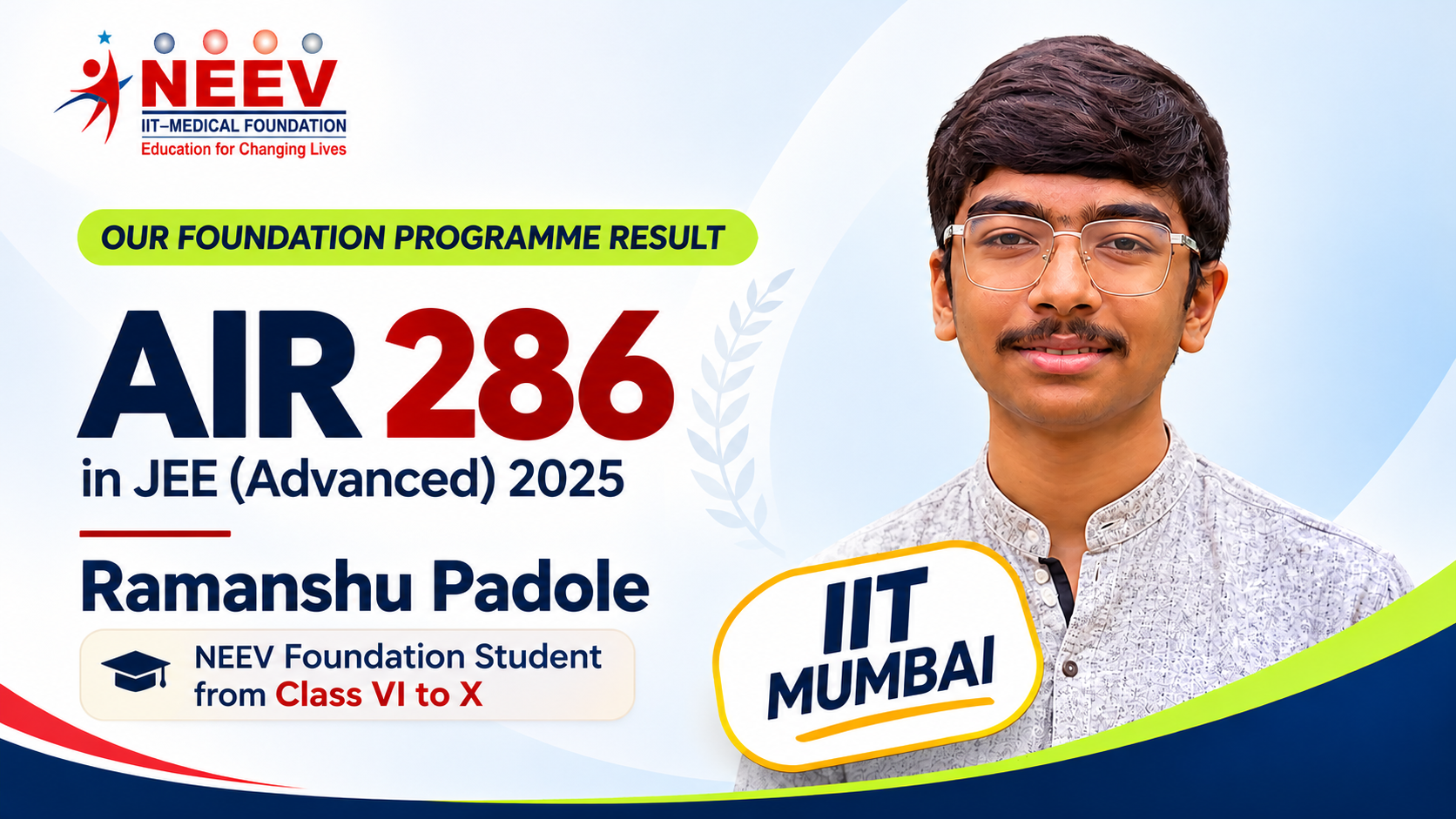
Proud Moment @ Neev Foundation
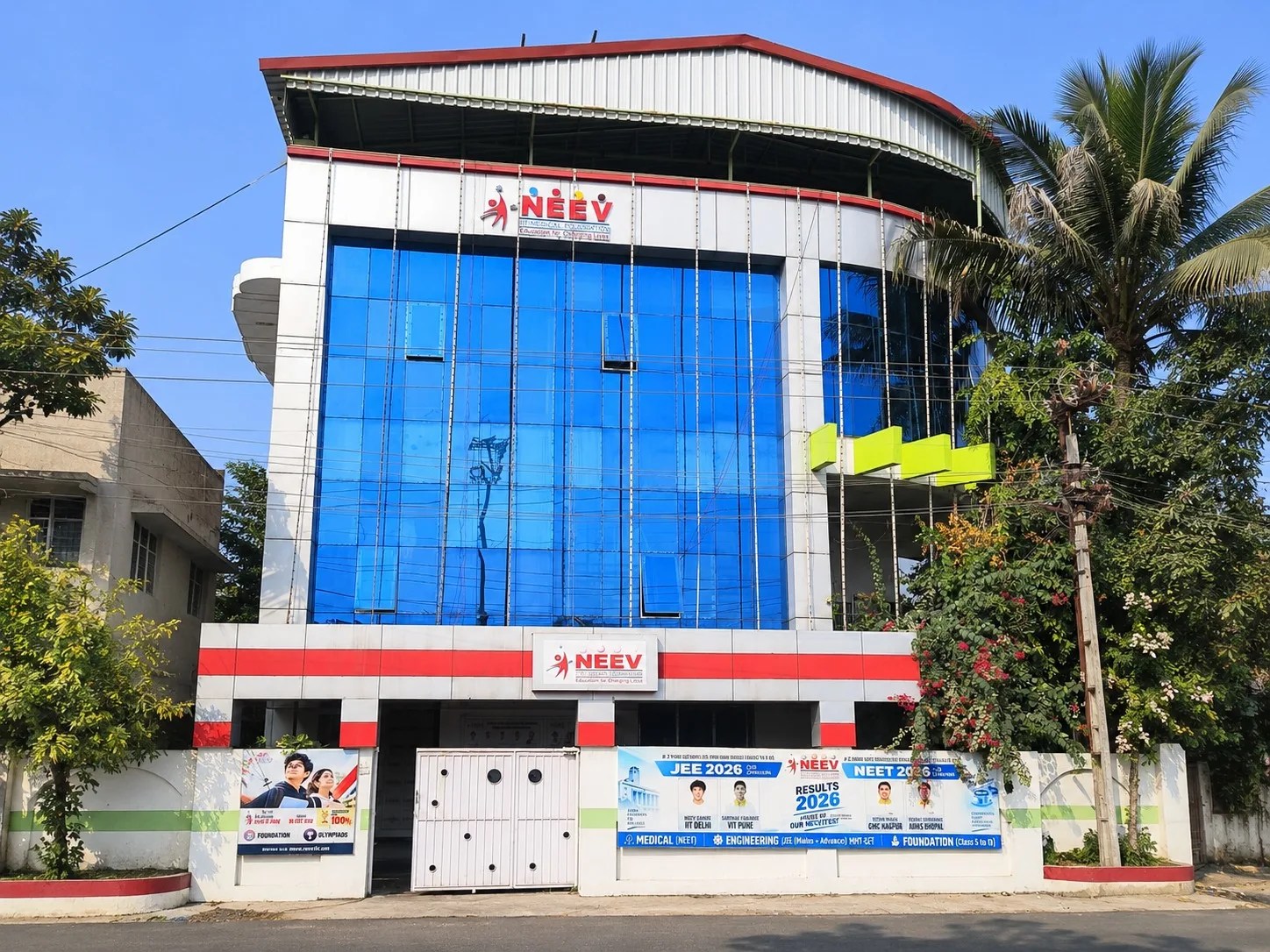
Neev IIT Medical Foundation
NeevAccelerate Talent Reward Exam – Award Function


#20 Years of Neev
Admission Open – Batch 2027-29 – For Class X Appearing Students
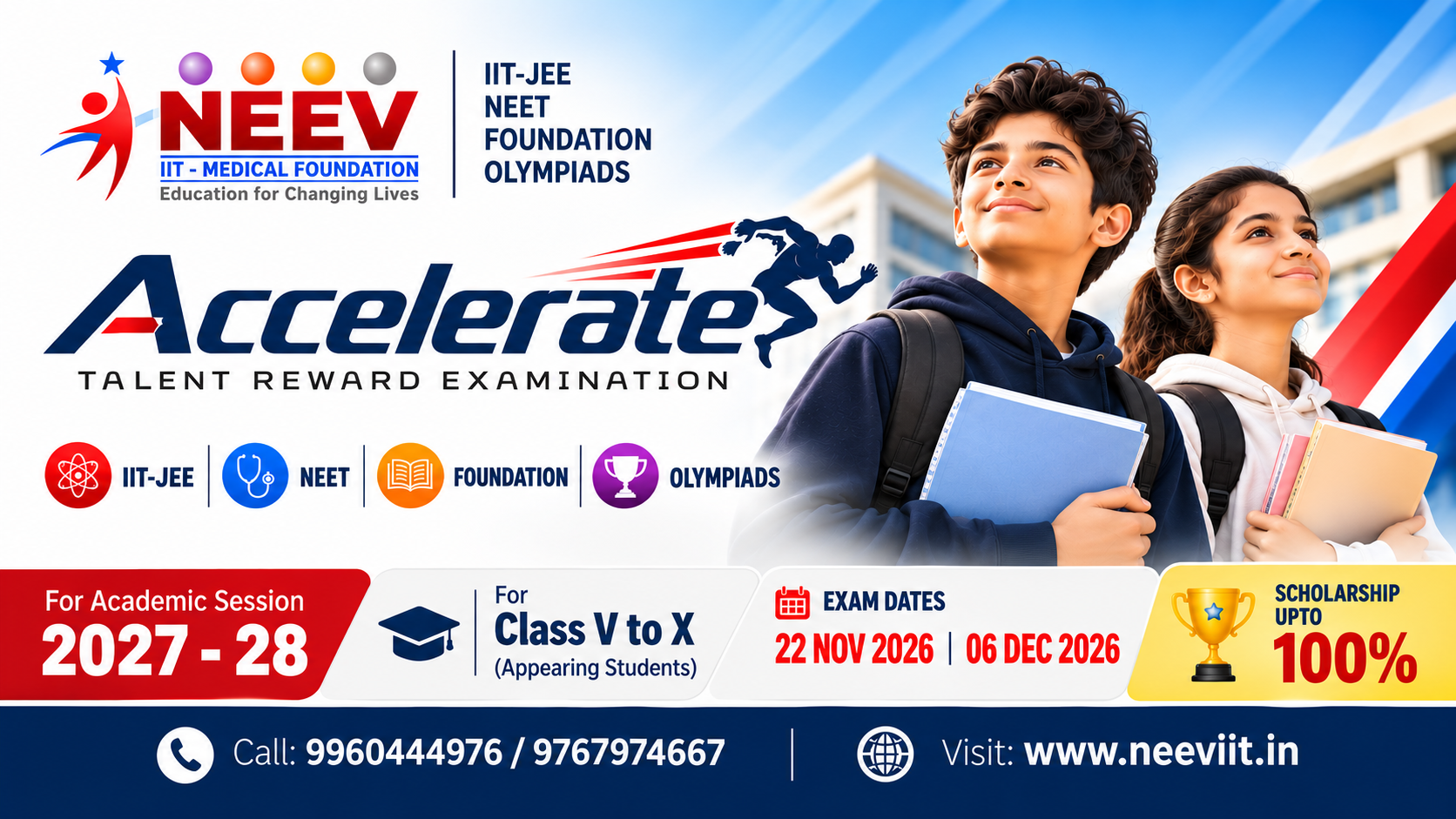
Neev Accelerate Talent Reward Exam 2026
JEE NEET Test Series 2027