Neev IIT Medical Foundation
Uncategorized
Why Foundation Courses in Class 6–10 Are Crucial for NEET/JEE Success
When it comes to preparing for NEET and JEE, parents often wonder: When should my child start? While many students begin in Class 11, the truth is that a strong foundation built in Classes 6–10 can be the game-changer that sets your child apart. Let’s understand why.
1. A Head Start in the Competition
Foundation courses give children early exposure to the style of questions, logical reasoning, and competitive exam mindset. This reduces the shock when they enter Class 11, making the journey smoother and less stressful.
2. Strong Basics = Strong Future
Every parent knows the importance of basics. NEET and JEE test conceptual understanding—not rote learning. Foundation programs help children master key concepts in Math and Science early so they don’t struggle later.
Example: A child confident with algebra in Class 9 will find advanced JEE-level mathematics far less intimidating.
3. Stress-Free Transition to Higher Classes
The leap from Class 10 to 11 can overwhelm students. Foundation training ensures your child already understands the basics, so they can focus on advanced topics without fear.
4. Better Discipline, Better Habits
Foundation courses encourage regular practice, time management, and doubt-solving habits. These skills aren’t just for exams—they shape your child into a consistent learner with strong study discipline.
5. Boost in School Exams Too
Worried that competitive preparation may affect school results? In fact, the opposite happens! Since the curriculum is aligned, foundation training often leads to higher marks in school and Olympiads.
6. Identifying Strengths & Weaknesses Early
Foundation courses help parents and students identify which subjects need more focus—long before board or entrance exams. This early insight allows for personalized learning strategies and targeted improvement.
7. Confidence in Olympiads & NTSE
Apart from NEET and JEE, foundation programs prepare children for Olympiads and NMTC. These achievements build confidence and strengthen problem-solving skills.
8. Reduced Pressure, Increased Confidence
Instead of cramming in Class 11 and 12, your child enters with a solid base and confidence, turning pressure into performance.
Final Message to Parents
Investing in foundation courses during Classes 6 –10 is not about pushing children too early—it’s about easing their future journey. By building strong fundamentals today, you give your child the gift of confidence, discipline, and a clear edge in the toughest exams tomorrow.
✅ Foundation today = Success tomorrow.
📢 Call to Action
If you want to give your child the right start towards NEET/JEE success:
- 📞 Call us today to know more about our foundation programs.
- 📝 Enroll now and secure your child’s future with strong fundamentals.
👉 Don’t wait until Class 11—start early, stay stress-free, and aim for the top ranks!
Share this:

Top 10 High-Weightage Chapters in NEET Chemistry (with Study Tips)
Introduction
Preparing for NEET Chemistry can feel overwhelming, but smart preparation can save you time and boost your score. Instead of trying to give equal weight to every topic, focus more on high-weightage chapters that NTA repeatedly asks in NEET. Here’s a guide to the 10 most important chapters in NEET Chemistry, their approximate weightage, and quick tips to master them.
1. Organic Chemistry – General Principles & Hydrocarbons
Weightage: 8–10 questions
Why important? Covers basics of reaction mechanisms, isomerism, and hydrocarbons.
Tip: Master reaction mechanisms (SN1, SN2, E1, E2) and practice NCERT-based examples.
2. Hydrocarbons & Aromatic Compounds
Weightage: 3–4 questions
Why important? Easy scoring if NCERT is done thoroughly.
Tip: Focus on benzene reactions, resonance, and directive influence.
3. Alcohols, Phenols & Ethers
Weightage: 3–4 questions
Why important? Frequently repeated in NEET, reaction-based questions.
Tip: Memorize reaction conversions with flowcharts.
4. Coordination Compounds
Weightage: 3–4 questions
Why important? Questions are direct and mostly NCERT-based.
Tip: Learn IUPAC naming, crystal field theory, and isomerism.
5. Chemical Bonding & Molecular Structure
Weightage: 3–4 questions
Why important? Fundamental to understanding the rest of Chemistry.
Tip: Revise VSEPR theory, MOT diagrams, and bond order regularly.
6. Equilibrium (Chemical + Ionic)
Weightage: 3–4 questions
Why important? Conceptual + numerical mix.
Tip: Practice pH calculations and Le Chatelier’s principle questions.
7. Electrochemistry
Weightage: 2–3 questions
Why important? Straightforward formulas + numericals.
Tip: Remember Nernst equation, conductance, and electrochemical series.
8. p-Block Elements (Class 11 & 12)
Weightage: 4–5 questions
Why important? Memory-based, NCERT-heavy.
Tip: Make short notes for trends, structures, and reactions.
9. Aldehydes, Ketones & Carboxylic Acids
Weightage: 3–4 questions
Why important? Very scoring if you master named reactions.
Tip: Prepare a chart of reactions (Aldol condensation, Cannizzaro, etc.).
10. Thermodynamics & Thermochemistry
Weightage: 2–3 questions
Why important? Easy numericals if formulas are strong.
Tip: Focus on 1st law, enthalpy, Hess’s law, and Gibbs free energy.
Quick NEET Chemistry Weightage (Approx.)
• Organic Chemistry: 35–40%
• Inorganic Chemistry: 30–35%
• Physical Chemistry: 25–30%
Study Tips for NEET Chemistry
✅ Stick to NCERT as your Bible – especially for Inorganic.
✅ Make reaction flowcharts for Organic Chemistry.
✅ Solve previous 10 years’ NEET Chemistry questions – 70% repeat in pattern.
✅ Take timed mock tests to improve speed and accuracy.
Final Words
Chemistry in NEET is often the deciding factor because it balances both scoring (Inorganic) and tricky (Organic) sections. By focusing on these high-weightage chapters, you can easily secure 120–140 marks in Chemistry with smart preparation.
👉 At Neev Foundation Wardha, our structured test series and doubt-solving sessions ensure every student builds confidence in Chemistry.
Share this:
🌟 Education is Changing: New Trends for Classes 5 to 10
🌟 Education is Changing: New Trends for Classes 5 to 10
School education in India is going through exciting changes! For students in Classes 5 to 10, learning is becoming more practical, skill-based, and future-ready. Here are some key trends every parent and student should know 👇
✅ NEP 2020 – New System
The government has introduced a 5+3+3+4 model. For Classes 5–10, this means less rote learning and more focus on concepts and skills. Exams will slowly test understanding, not just memorization.
✅ Digital & Smart Classrooms
From tablets to robotics and AI, technology is entering classrooms. Students are learning coding, digital tools, and problem-solving from middle school itself.
✅ Personalized Learning
Apps and smart platforms now allow children to learn at their own pace. Fast learners get advanced practice, while others receive extra support.
✅ Life Skills & Sports
Schools are giving more importance to communication, teamwork, and fitness. Physical education is now part of the structured curriculum.
✅ Mother Tongue + English
Many schools are using bilingual methods to ensure better understanding, especially in early classes.
✅ Bridging Gaps
Special remedial programs are helping students who fell behind during the pandemic, so no one is left behind.
✅ Future Skills
Initiatives like SOAR are teaching students AI and digital skills, preparing them for tomorrow’s jobs.
✨ Why this matters
- Makes learning fun & stress-free
- Builds confidence & creativity
- Prepares children for future careers
- Focuses on overall growth, not just marks
📌 Today’s students are not just exam-takers, they are future problem-solvers and innovators. Let’s encourage them to embrace these new learning opportunities! 🚀
#Lets keep our child updated ! ………….Dr Mohan Sawade , Founder , Neev Foundation – A True Education Initiative
Share this:


NeevAccelerate Talent Reward Examination 2025 – Zero Registration Fees . Register Online
Academic Session 2025 – 26
NeevAccelerate Talent Reward Examination 2025 – Zero Registration Fees . For Students preparing for Foundation/JEE/NEET programs.

Share this:

AMTI- NMTC Final – Year 2022 Test Papers – All Levels
AMTI- NMTC Final – All Levels Year 2022 Test Papers
Share this:
Dr Homi Bhabha Bal Vaidyanik Competition Stage 1 – Answer Key – 21 Oct’23
Class VI and Class IX – Answer Key – 21 Oct’23
Share this:
Ganit Pradnya Result 2023

Subscribe to continue reading
Subscribe to get access to the rest of this post and other subscriber-only content.
Share this:
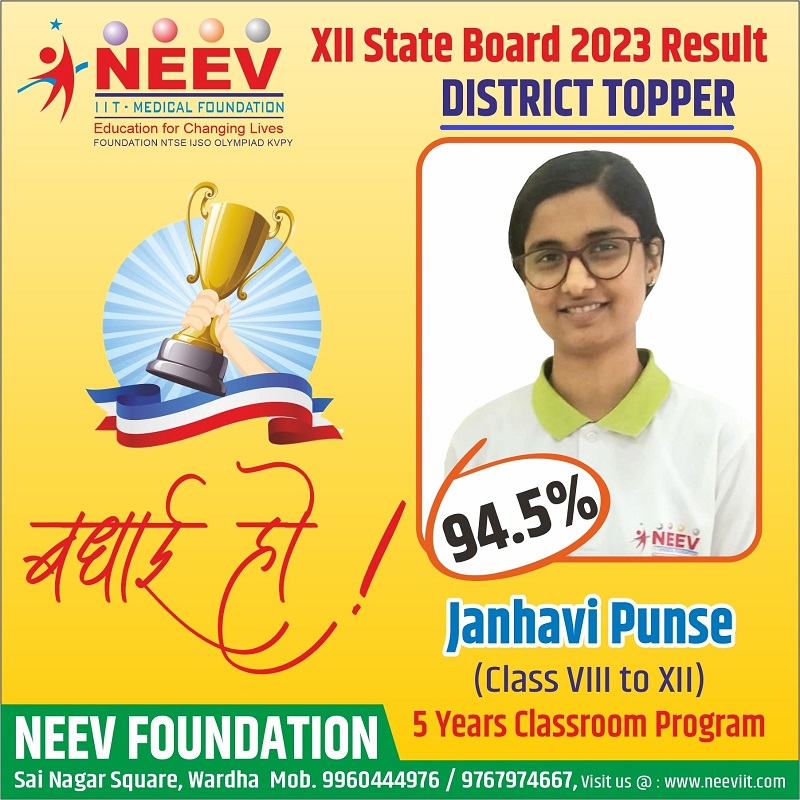


#Results 2025

Ad,issions Open

Neev Accelerate Talent Reward Exam 2026

JEE(Mains +Advance) Test Series 2026



 Neev IIT Medical Foundation