Neev IIT Medical Foundation
science
NEST 2026 Explained: Career Scope, Benefits & IISER vs JEE Advanced- For Class XII Appearing and Passed Students
For science students who love thinking, concepts, and curiosity-driven learning, the National Entrance Screening Test (NEST) 2026 offers a powerful alternative to traditional entrance exams. NEST is designed for students who aspire to build a career in research, academia, and innovation, rather than only professional degrees.
With growing global demand for scientists, researchers, and problem-solvers, NEST is becoming an increasingly important exam for Class XI–XII students.
What is NEST 2026?
The National Entrance Screening Test (NEST) is a national-level entrance exam conducted for admission to 5-year Integrated MSc programmes in:
- Physics
- Chemistry
- Mathematics
- Biology
Admissions are offered at two premier institutes supported by the Department of Atomic Energy:
- National Institute of Science Education and Research (NISER), Bhubaneswar
- UM–DAE Centre for Excellence in Basic Sciences (CEBS), Mumbai
NEST focuses on conceptual clarity, analytical reasoning, and scientific aptitude, making it ideal for students with a strong interest in pure sciences.
Important Dates for NEST 2026
- Application Opens: 5 January 2026
- Last Date to Apply: 6 April 2026
- Admit Card Download: 15 May 2026
- Exam Date: 6 June 2026 (Saturday)
Early awareness and preparation significantly improve performance in NEST.
Career Benefits of Clearing NEST
1. Early Entry into Research
NEST-qualified students begin research-oriented learning from the undergraduate level. This includes:
- Laboratory training
- Research projects
- Scientific presentations
This early exposure builds a strong base for higher studies and innovation.
2. Strong Future Academic Pathways
After completing the Integrated MSc, students can pursue:
- PhD in India or abroad
- MS/PhD at top global universities
- Research roles in national laboratories and scientific organisations
NEST graduates are highly valued in both academic and research ecosystems.
3. Financial Support & Stability
Students admitted through NEST receive:
- Monthly scholarships
- Research funding opportunities
- Summer internships and academic exposure
This makes research education financially sustainable.
NEST vs IISER vs JEE Advanced: A Clear Comparison
Many students are confused about choosing between NEST, IISER Aptitude Test, and JEE Advanced. Here is a simple comparison:
NEST
- Focus: Pure science & research
- Skills Tested: Conceptual understanding, analytical thinking
- Best for: Students interested in becoming scientists, researchers, academicians
- Course: 5-year Integrated MSc
IISER Aptitude Test
- Focus: Research-oriented science education
- Skills Tested: Concepts + aptitude
- Best for: Students interested in interdisciplinary sciences
- Course: BS–MS dual degree
JEE Advanced
- Focus: Engineering and applied sciences
- Skills Tested: High-level problem solving & speed
- Best for: Students aiming for IIT engineering programs
- Course: BTech / BS
👉 Key difference:
JEE Advanced rewards speed and competition, while NEST and IISER reward depth, reasoning, and curiosity.
Students preparing for JEE Advanced often find NEST preparation complementary, as both demand strong fundamentals—but NEST is more research-focused.
Who Should Choose NEST?
NEST is ideal for students who:
- Enjoy Physics, Chemistry, Maths, or Biology deeply
- Like understanding why and how, not just what
- Prefer research, discovery, and innovation
- Are considering long-term academic or scientific careers
Final Thoughts
NEST 2026 is not just an entrance exam—it is a gateway to a future in science, research, and global innovation. In an era where scientific thinking drives progress, NEST offers students a respected, stable, and intellectually rewarding career path.
If you have curiosity, patience, and a love for concepts, NEST 2026 could be the right step toward a meaningful scientific career. Know More 9960444976
Share this:

Top 10 High-Weightage Chapters in NEET Chemistry (with Study Tips)
Introduction
Preparing for NEET Chemistry can feel overwhelming, but smart preparation can save you time and boost your score. Instead of trying to give equal weight to every topic, focus more on high-weightage chapters that NTA repeatedly asks in NEET. Here’s a guide to the 10 most important chapters in NEET Chemistry, their approximate weightage, and quick tips to master them.
1. Organic Chemistry – General Principles & Hydrocarbons
Weightage: 8–10 questions
Why important? Covers basics of reaction mechanisms, isomerism, and hydrocarbons.
Tip: Master reaction mechanisms (SN1, SN2, E1, E2) and practice NCERT-based examples.
2. Hydrocarbons & Aromatic Compounds
Weightage: 3–4 questions
Why important? Easy scoring if NCERT is done thoroughly.
Tip: Focus on benzene reactions, resonance, and directive influence.
3. Alcohols, Phenols & Ethers
Weightage: 3–4 questions
Why important? Frequently repeated in NEET, reaction-based questions.
Tip: Memorize reaction conversions with flowcharts.
4. Coordination Compounds
Weightage: 3–4 questions
Why important? Questions are direct and mostly NCERT-based.
Tip: Learn IUPAC naming, crystal field theory, and isomerism.
5. Chemical Bonding & Molecular Structure
Weightage: 3–4 questions
Why important? Fundamental to understanding the rest of Chemistry.
Tip: Revise VSEPR theory, MOT diagrams, and bond order regularly.
6. Equilibrium (Chemical + Ionic)
Weightage: 3–4 questions
Why important? Conceptual + numerical mix.
Tip: Practice pH calculations and Le Chatelier’s principle questions.
7. Electrochemistry
Weightage: 2–3 questions
Why important? Straightforward formulas + numericals.
Tip: Remember Nernst equation, conductance, and electrochemical series.
8. p-Block Elements (Class 11 & 12)
Weightage: 4–5 questions
Why important? Memory-based, NCERT-heavy.
Tip: Make short notes for trends, structures, and reactions.
9. Aldehydes, Ketones & Carboxylic Acids
Weightage: 3–4 questions
Why important? Very scoring if you master named reactions.
Tip: Prepare a chart of reactions (Aldol condensation, Cannizzaro, etc.).
10. Thermodynamics & Thermochemistry
Weightage: 2–3 questions
Why important? Easy numericals if formulas are strong.
Tip: Focus on 1st law, enthalpy, Hess’s law, and Gibbs free energy.
Quick NEET Chemistry Weightage (Approx.)
• Organic Chemistry: 35–40%
• Inorganic Chemistry: 30–35%
• Physical Chemistry: 25–30%
Study Tips for NEET Chemistry
✅ Stick to NCERT as your Bible – especially for Inorganic.
✅ Make reaction flowcharts for Organic Chemistry.
✅ Solve previous 10 years’ NEET Chemistry questions – 70% repeat in pattern.
✅ Take timed mock tests to improve speed and accuracy.
Final Words
Chemistry in NEET is often the deciding factor because it balances both scoring (Inorganic) and tricky (Organic) sections. By focusing on these high-weightage chapters, you can easily secure 120–140 marks in Chemistry with smart preparation.
👉 At Neev Foundation Wardha, our structured test series and doubt-solving sessions ensure every student builds confidence in Chemistry.
Share this:
#Results 2025
Ad,issions Open

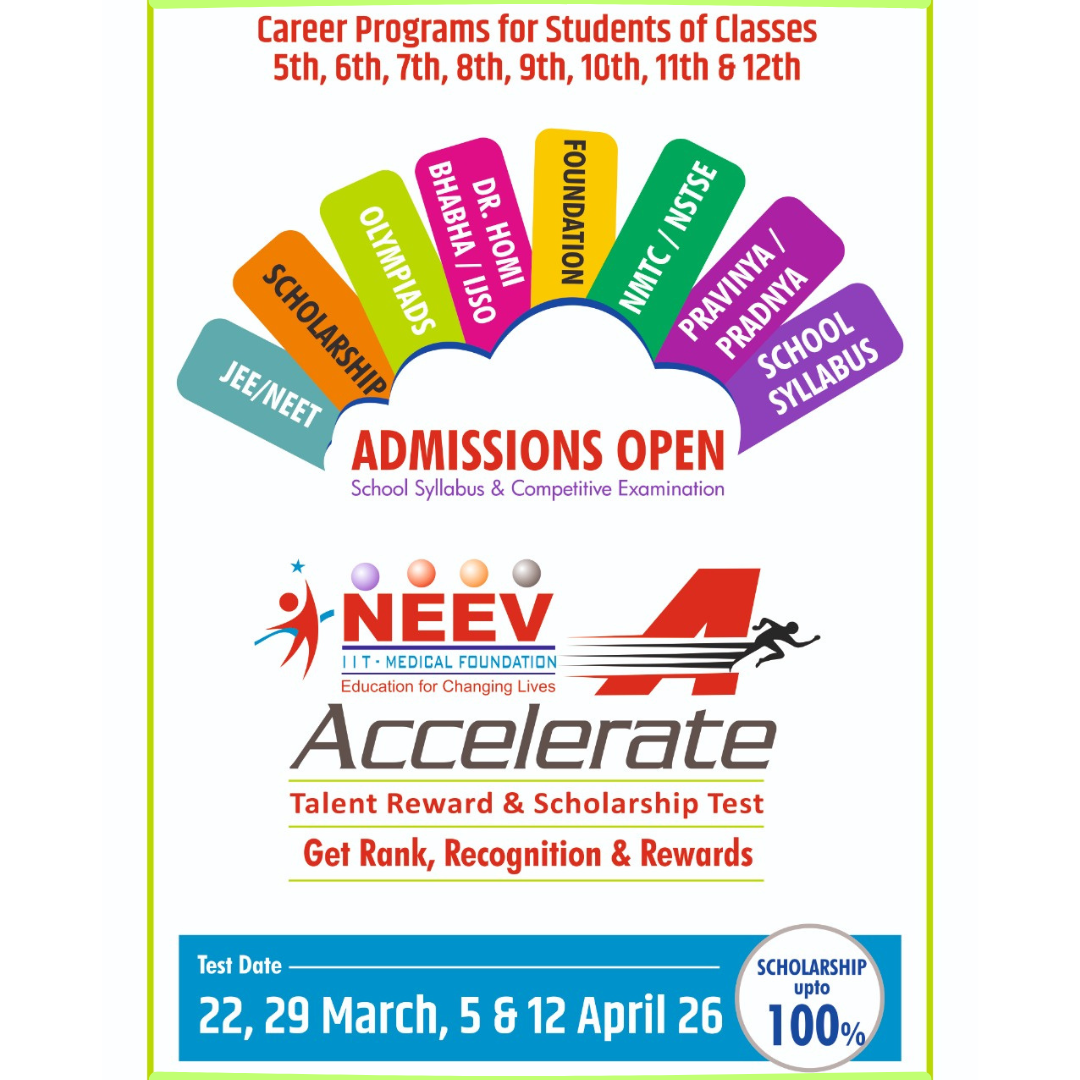
Neev Accelerate Talent Reward Exam 2026
Accellerate Talent Reward Exam’26


 Neev IIT Medical Foundation