Neev IIT Medical Foundation
education
IISER Aptitude Test (IAT) 2026 – Important Dates, Exam Details & Complete Guide
The IISER Aptitude Test (IAT) 2026 is the gateway to admission into India’s prestigious Indian Institutes of Science Education and Research (IISERs). If you aspire to build a career in scientific research, innovation, or interdisciplinary sciences, this exam is your opportunity.
This blog covers important dates, application details, exam timing, and preparation strategy for IAT 2026.
📅 IAT 2026 – Important Dates
Here are the key dates every aspirant must remember:
- Application Portal Opens: 5 March 2026
- Application Portal Closes: 13 April 2026 (11:55 PM IST)
- Correction Window: 16 April – 18 April 2026
- Hall Ticket Release: 24 May 2026
- IISER Aptitude Test (IAT) 2026: Sunday, 7 June 2026
🕘 9:00 AM – 12:00 Noon (IST)
👉 Students are strongly advised not to wait for the last date to apply.
🎓 Programs Offered Through IAT 2026
Through IAT 2026, students can take admission into:
- 5-Year BS-MS Program (All IISERs)
- BS-MS in Computational & Data Sciences (IISER Kolkata)
- Major in Geology (IISER Mohali)
- Major in Environmental Sciences (IISER Mohali)
- 4-Year BS in Economic Sciences (IISER Bhopal)
- 4-Year BS in Economic & Statistical Sciences (IISER Tirupati)
- 4-Year B.Tech in Chemical Engineering (IISER Bhopal)
- 4-Year B.Tech in Electrical Engineering & Computer Science (IISER Bhopal)
- 4-Year B.Tech in Data Science & Engineering (IISER Bhopal)
These programs are designed to build strong foundations in scientific research, interdisciplinary learning, and innovation.
🔬 Why Choose IISER?
IISERs are known for:
✔️ Research-oriented curriculum
✔️ Strong faculty & mentorship
✔️ Early research exposure
✔️ Interdisciplinary flexibility
✔️ Excellent higher education opportunities (India & abroad)
If you aim for a future in research, academia, data science, scientific innovation, or higher studies, IISER is an outstanding platform.
📝 Exam Pattern Overview (IAT)
IAT will consist of 60 questions, 15 questions each from Biology, Chemistry, Mathematics, and Physics.
Total duration of the test will be 180 minutes. Questions will be of multiple choice type. Each question will have only one correct answer.
- Each correct answer will be awarded 4 marks.
- Each incorrect answer will lead to the deduction of 1 mark.
- Unanswered questions will be awarded 0 mark.
- Therefore, maximum marks in IAT will be 240.
The total marks obtained by a candidate out of 240 will be considered for preparing the Rank List.
📚 Preparation Strategy for IAT 2026
- Strengthen NCERT fundamentals (Class 11 & 12).
- Focus on conceptual clarity.
- Practice mixed-subject mock tests.
- Improve speed + accuracy.
- Revise weak areas systematically.
Students preparing for JEE or NEET can also target IAT with focused additional preparation.
⚠️ Important Advice
- Apply early.
- Keep documents ready.
- Track official notifications.
- Start revision at least 3–4 months before the exam.
Remember: IAT rewards conceptual clarity and scientific thinking.
🎯 Final Words
IAT 2026 is more than just an entrance exam — it is an entry into India’s premier research ecosystem.
If you are passionate about science and want to build a career beyond conventional engineering or medical paths, IISER can be your perfect destination.
Start preparing today.
Your research journey begins with IAT 2026.
Share this:

National Science Day in the Age of AI: Why Scientific Thinking Matters More Than Ever
Every year on 28th February, India celebrates National Science Day to honor Sir C. V. Raman’s discovery of the Raman Effect. Traditionally, this day reminds us of scientific achievements and innovation.
But in today’s world — shaped by Artificial Intelligence, machine learning, and tools like ChatGPT — the relevance of scientific thinking has become even more powerful.
The AI Revolution and Science
Artificial Intelligence is transforming how we learn, work, and solve problems. Students today can ask ChatGPT to explain complex concepts, solve equations, summarize chapters, or generate ideas instantly.
However, here is the crucial question:
Are we using AI to think better — or to avoid thinking?
AI is built on science. It is powered by mathematics, algorithms, data analysis, and logical reasoning. Without scientific principles, AI would not exist.
National Science Day reminds us that behind every powerful AI tool lies deep scientific research and disciplined experimentation.
ChatGPT and the Importance of Concepts
Tools like ChatGPT can assist students, but they cannot replace understanding. AI can provide answers, but it cannot build clarity unless the student actively engages with the concept.
In competitive exams like JEE and NEET, success depends on:
- Strong fundamentals
- Logical reasoning
- Application of concepts
- Analytical problem-solving
AI can support preparation, but only scientific thinking ensures mastery.
Scientific Thinking in the Digital Era
Scientific temperament includes:
- Asking “Why?”
- Verifying information
- Testing ideas
- Thinking critically
- Learning from mistakes
In the age of AI-generated information, critical thinking becomes even more important. Not everything generated by technology is perfect. Students must learn to question, cross-check, and analyze.
Science teaches us discipline. AI accelerates information. But wisdom comes from understanding.
From Discovery to Digital Innovation
Sir C. V. Raman’s discovery was the result of observation, experimentation, and persistence. Today’s breakthroughs in AI follow the same path — research, testing, failure, refinement, and improvement.
The tools have changed.
The scientific mindset has not.
National Science Day reminds us that progress — whether in physics labs or AI laboratories — begins with curiosity and rigorous thinking.
The Way Forward for Students
In today’s world, students must:
- Use AI as a learning assistant, not a shortcut
- Strengthen conceptual foundations
- Develop independent problem-solving skills
- Cultivate discipline and curiosity
AI will evolve. Technology will advance. But the foundation of success will always be scientific thinking.
Conclusion
National Science Day is no longer just about celebrating past discoveries. It is about preparing students for a future where science and technology shape every industry.
Artificial Intelligence is powerful.
But the human mind, trained in scientific thinking, remains irreplaceable.
Let us celebrate science not only as a subject, but as a mindset — one that empowers innovation, responsibility, and excellence in the age of AI.
Share this:
HSC & CBSE Board Exams Are About to Begin: A Calm, Smart Approach for Class 10 & Class 12 Students
The HSC and CBSE Board Examinations for Class 10 and Class 12 are about to begin. This is a crucial phase, especially for Class 12 students, as these exams play an important role in college admissions, competitive exams, and future academic plans.
It is natural to feel pressure — but with the right mindset and strategy, this period can be handled confidently.
1. For Class 12 Students: Boards Matter, But Calm Matters More
Class 12 board exams demand:
- Strong conceptual understanding
- Clear step-wise answers
- Proper presentation and time management
Remember:
👉 Boards test how well you express what you know, not how stressed you are.
If your basics are clear, consistent revision is enough at this stage.
2. What Students Should Focus on Right Now (Class 10 & 12)
✔ Smart Revision, Not New Learning
This is not the time to start entirely new topics. Focus on:
- NCERT textbook questions
- Important formulas and derivations (especially for Class 12)
- Definitions, diagrams, and numericals
- Previous years’ board questions
✔ Answer Writing Practice (Very Important for Class 12)
Marks are often lost due to poor presentation, not lack of knowledge.
- Write answers in points
- Show all steps in numericals
- Highlight final answers
- Use proper headings and diagrams
3. Common Mistakes to Avoid in the Last Days
❌ Studying till late night every day
❌ Overloading the brain with too many mock papers
❌ Comparing performance with friends
❌ Ignoring food, sleep, and breaks
👉 A fresh, well-rested mind performs better than an exhausted one.
4. Exam-Day Strategy (Especially for Class 12)
- Reach the exam centre early
- Read the question paper carefully
- Attempt known questions first
- Manage time section-wise
- Keep last 10–15 minutes for revision
Neat presentation + correct concepts = maximum marks.
5. A Special Note for Parents of Class 12 Students
Parents, your support is crucial right now.
Please:
- Avoid unnecessary pressure about results
- Encourage effort and consistency
- Ensure proper sleep and meals
- Stay calm — anxiety spreads quickly at home
A supportive environment helps students perform to their true potential.
6. Remember: Boards Are Important, But Not Everything
For Class 12 students, board exams are a major milestone, but not the end of the journey. Competitive exams, college life, and careers are long paths.
What truly matters is:
- Discipline
- Confidence
- The habit of learning
Final Words
As HSC and CBSE Class 10 & Class 12 board exams begin:
Stay calm, trust your preparation, and focus on giving your best.
We wish all students — especially our Class 12 board aspirants — the very best for their exams.
🏫 Neev IIT–Medical Foundation
📕📗📘📙 Learn • Practice • Excel
Share this:
CBSE’s New Directive on Student Well-Being: A Step Towards Holistic Education — and How Neev Is Aligning with This Vision
In a progressive and much-needed move, the Central Board of Secondary Education (CBSE) has issued a directive making emotional counselling and wellness support mandatory in schools. As highlighted in the recent newspaper article, CBSE has recommended the appointment of one counsellor or wellness teacher for every 500 students, signalling a clear shift in how student development is viewed in India.
This directive reinforces a growing truth: academic excellence cannot be separated from emotional well-being.
Why This Directive Was Necessary
Over the past decade, educators have observed a steady rise in:
- Academic stress and performance anxiety
- Fear of failure and comparison
- Emotional imbalance during board and competitive exam years
- Difficulty in decision-making and career clarity
Students today face pressures that go far beyond textbooks. CBSE’s directive acknowledges this reality and aims to create structured emotional support systems within schools, rather than treating mental well-being as an afterthought.
Who Is a Counsellor or Wellness Teacher?
According to CBSE’s framework:
- Schools must appoint a qualified counsellor or wellness teacher
- Professionals may include trained psychologists, counsellors, or certified teachers
- Proper academic qualifications and training in counselling or mental health are essential
At the secondary and senior secondary levels, CBSE further encourages schools to appoint:
- A counsellor
- A wellness teacher
- A career guidance professional (where possible)
This ensures a balanced focus on emotional, social, and career development.
Key Responsibilities Outlined by CBSE
The directive clearly defines the role of these professionals:
✔ Emotional & Mental Health Support
Helping students cope with stress, anxiety, self-doubt, and emotional challenges.
✔ Preventive Guidance
Identifying early warning signs of emotional or behavioural issues and intervening before they escalate.
✔ Career Awareness & Guidance
Supporting students in understanding their strengths, interests, and realistic career pathways.
✔ Support for Teachers & Parents
Guiding teachers in handling sensitive students and helping parents understand emotional needs during crucial academic years.
Implementation Flexibility for Schools
CBSE has allowed flexibility based on school size:
- Schools with fewer than 300 students (Classes 9–12) may appoint counsellors on a part-time basis
- Larger schools are expected to ensure full-time counselling support
- Clear role definitions are mandatory to avoid overlap and confusion
This ensures that both large and small schools can implement the directive effectively.
A Shift from Marks-Centric to Student-Centric Education
This initiative marks a fundamental shift in Indian education:
From measuring success only through marks → to nurturing emotionally strong, confident learners
CBSE’s message is clear:
- Emotional intelligence matters
- Mental health is non-negotiable
- Schools must prepare students not just for exams, but for life
How Neev Is Aligning Its Strategy with This Vision
At Neev, this directive does not come as a surprise—it reinforces a philosophy we have believed in and practiced for years.
Our academic strategy is being consciously aligned to ensure that:
- Concept clarity is prioritised over pressure
- Regular mentoring and doubt-clearing reduce anxiety
- Exam preparation is structured, not rushed
- Students are guided emotionally, not compared constantly
We are strengthening:
- One-on-one mentoring interactions
- Stress-management discussions during peak academic phases
- Career awareness conversations alongside academic planning
- A classroom environment where questions, doubts, and concerns are welcomed
At Neev, we believe that strong emotional foundations lead to consistent academic performance—especially in board exams and competitive exams like JEE and NEET.
A Mentor’s Note
As someone who has spent over 20 years in the education fraternity, working closely with students, parents, and teachers, I have seen how academic pressure can quietly affect young minds. Marks and ranks are important, but clarity, confidence, and emotional balance are what sustain students in the long run.
CBSE’s initiative is a timely reminder that education must remain humane. At Neev, we are committed to aligning our strategies with this vision—ensuring that every student is supported not just academically, but emotionally as well.
Because when students feel understood,
learning becomes meaningful—and success follows naturally.
— Dr. Mohan Sawade , Founder and Director. Reach us @ info@neeviit.com
Share this:
Is JEE Advanced Moving Towards Adaptive Testing ?
What It Means, Its Pros & Cons, and How Students, Parents, and Coaching Must Respond
JEE Advanced has always evolved to stay ahead of rote learning and pattern-based preparation. Recent trends suggest that the examination is exploring adaptive-style assessment principles—not as an immediate implementation, but as a possible future direction.
⚠️ Important clarification upfront
JEE Advanced 2026 is NOT an adaptive test.
The 2026 examination will be conducted in the existing format.
However, the performance data and response patterns of the 2026 batch are expected to serve as a reference sample, based on which future examination strategies may be evaluated.
Understanding this distinction is essential for students and parents.
🔍 What Is Adaptive Testing?
Adaptive testing refers to an assessment philosophy where:
- The exam focuses on depth of understanding, not repetition
- Questions are layered from basic concepts to advanced applications
- Partial knowledge is exposed and penalised
- Accuracy, judgement, and composure matter as much as knowledge
⚠️ Clarification again
Adaptive testing here refers to exam design philosophy, not a computer-controlled question-by-question adaptive system like CAT.
🧪 Role of the JEE Advanced 2026 Batch (Sample / Reference Group)
Educational analysts believe that:
- The JEE Advanced 2026 batch will act as a reference or sample group
- Their performance data will help exam authorities study:
- How students respond to higher conceptual depth
- Accuracy vs attempt behaviour
- Time management and decision-making patterns
- Based on this statistical and behavioural analysis, authorities may:
- Decide whether adaptive elements should be introduced
- Determine the extent and manner of any future changes
In simple words:
2026 is a data-gathering and evaluation phase, not an implementation phase.
Any structural change, if approved, would be introduced only in later years, after careful analysis.
🔁 How This Differs from Conventional JEE Advanced
Conventional Approach
- More predictable structure
- Familiar question types
- Advantage to repeated practice
- Speed and volume of attempts mattered more
Direction Being Evaluated
- Reduced dependence on fixed patterns
- Greater emphasis on concept integration
- Accuracy over number of attempts
- Stronger testing of exam temperament
This shift aims to assess quality of thinking, not quantity of practice.
✅ Pros of an Adaptive-Style Approach (If Implemented in the Future)
1️⃣ Rewards True Conceptual Understanding
Students who understand concepts deeply benefit more than those relying on memorisation.
2️⃣ Reduces Guesswork and Luck
Multiple-correct and numerical-type questions discourage blind attempts.
3️⃣ Better Rank Differentiation
Adaptive-style assessment separates students more meaningfully, especially at the top.
4️⃣ Aligns with IIT Academic Demands
The focus moves closer to:
- Problem-solving
- Logical reasoning
- Handling unfamiliar situations
⚠️ Challenges and Concerns
1️⃣ Psychological Pressure
Unpredictability can increase anxiety if students are not mentally prepared.
2️⃣ Time and Risk Management
Students must decide not only how to solve, but whether to attempt.
3️⃣ Partial Preparation Gets Exposed
Surface-level learning becomes ineffective.
🎓 Role of Students
Students should:
- Build strong fundamentals
- Practise mixed-concept questions
- Learn intelligent question selection
- Develop calmness under uncertainty
In such exams:
Attempt quality matters more than attempt quantity.
👨👩👧 Role of Parents
Parents should:
- Understand that rank fluctuations are natural, especially during transition years
- Avoid judging ability based on a single test
- Focus on consistency, not instant results
- Provide emotional stability at home
A calm parent environment supports better exam performance.
🏫 Is This Making JEE Advanced More Coaching-Dependent?
No — if anything, it reduces coaching dependency.
- Pattern-based shortcuts lose effectiveness
- Conceptual clarity and independent thinking gain importance
- Expensive material alone offers no advantage
Good coaching helps guide thinking, but cannot replace understanding.
🌾 Impact on Rural and Resource-Limited Students
Potential Positives
- Reduced advantage of pattern-heavy coaching
- Greater importance of NCERT-based fundamentals
- Less reward for rote memorisation
Real Challenges
- Limited access to mentors and adaptive-style practice
- Digital and resource gaps
With proper guidance and access, adaptive assessment can be more inclusive, not less.
🧠 Final Perspective
To summarise clearly:
- JEE Advanced 2026 will NOT be adaptive
- The 2026 batch serves as a reference sample
- Any adaptive-style implementation, if approved, would be introduced only in future years
- The goal is to identify genuine conceptual thinkers, not pattern-trained candidates
Students, parents, and coaching institutes who understand this evolution early will be better prepared, not anxious. Know More 9960444976
🏫 Our Response at Neev IIT Foundation
Understanding the evolving nature of JEE Advanced and the possible future move towards adaptive-style assessment, Neev IIT Foundation has proactively strengthened its academic ecosystem.
As part of this effort, several IITians and Medicos have been added to the Neev academic team, bringing with them:
- Deep conceptual teaching experience
- First-hand understanding of IIT and medical entrance expectations
- Strong focus on problem-solving, accuracy, and exam temperament
- Mentorship that goes beyond syllabus completion
Their role is not just to teach, but to train students to think, adapt, and stay composed—skills that are increasingly crucial in JEE Advanced.
Our objective is clear:
To prepare students not just for an exam pattern, but for any evolution the exam may undergo.
With strong fundamentals, guided mentorship, and emotional balance, students can face both present and future challenges of JEE Advanced with confidence.
Share this:
Swami Vivekananda Jayanti: A Message for JEE & NEET Aspirants
Every year, Swami Vivekananda Jayanti reminds India of the power of youth, discipline, and fearless effort. For students preparing for JEE and NEET, his life and words feel especially relevant—almost as if they were written for today’s competitive exam warriors.
Swami Vivekananda believed that education is not about memorising facts, but about building character, confidence, and clarity of thought. This is exactly what JEE and NEET demand—not just knowledge, but the ability to apply concepts under pressure.
🔥 Strength Over Fear
Vivekananda famously said, “Strength is life, weakness is death.”
For aspirants, fear of failure, syllabus load, and mock-test scores often become mental barriers. His message is clear: mental strength matters as much as academic preparation. A calm, confident mind performs better than an anxious one.
📘 Discipline Is the Real Secret
JEE and NEET are not cracked by last-minute miracles. They are won by:
- Daily discipline
- Consistent revision
- Patience over months and years
Vivekananda’s own life was built on self-control and focus—exactly the traits required to sit with NCERT, solve problems, and improve steadily.
🧠 Believe in Yourself
One of his most powerful teachings was:
“You cannot believe in God until you believe in yourself.”
For students, this translates to self-belief during low mock scores, tough chapters, and slow progress. Every topper’s journey includes doubt—but belief keeps them moving forward.
🌱 Education with Purpose
Vivekananda wanted education to create strong individuals who serve society.
NEET aspirants preparing to become doctors and JEE aspirants aiming to become engineers are, in essence, preparing to serve the nation. This larger purpose gives meaning to long study hours and sacrifices.
🎯 A Message to Students
On this Swami Vivekananda Jayanti, remember:
- Your effort matters more than comparison
- Your journey is unique
- Your potential is far greater than your current rank
✨ Final Thought
JEE and NEET are tough exams—but they are also character-building journeys. Swami Vivekananda reminds every aspirant that with discipline, courage, and belief, no goal is unreachable.
Arise. Awake. And study with purpose. Call us 9960444976
Share this:
MHT-CET 2026 (PCM & PCB) : Registration Open | How It Compares with JEE Main
With Admissions Open for 2026–27, students aiming for engineering, pharmacy, and medical-related courses in Maharashtra must clearly understand MHT-CET and how it differs from JEE Main. While both exams test Physics, Chemistry, and Mathematics, their purpose, difficulty level, syllabus focus, and admission scope are very different.
This blog will help students and parents make a smart, stress-free choice.
What is MHT-CET 2026 (PCM / PCB)?
MAH–MHT CET 2026 is a state-level entrance examination conducted for admission to undergraduate courses in Maharashtra.
Key Highlights
- Courses: Engineering, Pharmacy, Agriculture & allied fields
- Streams:
- PCM – Engineering & Technology
- PCB – Pharmacy, Agriculture, Life Sciences
- Mode: Online (Computer-Based Test)
- Attempts: Two attempts (best score considered)
- Eligibility Focus: Maharashtra State candidates (with some All India quota seats)
📝 Registration: 10 January – 12 February 2026
🧪 Exam Window: April–May 2026
🎓 Admissions Open for 2026–27
What is JEE Main?
JEE Main is a national-level entrance exam for admission to:
- NITs, IIITs, CFTIs
- Eligibility for JEE Advanced (IITs)
It is more competitive and conceptually demanding, especially in Physics and Mathematics.
MHT-CET vs JEE Main: Detailed Comparison
| Feature | MHT-CET (PCM/PCB) | JEE Main |
|---|---|---|
| Exam Level | State-level (Maharashtra) | National-level |
| Difficulty | Moderate | High |
| Syllabus Focus | NCERT + Maharashtra State Board | Pure NCERT (deep concepts) |
| Question Style | More numerical & direct | Highly conceptual & tricky |
| Maths Weightage | Very high (PCM) | High but balanced |
| Negative Marking | ❌ No | ✅ Yes |
| Number of Attempts | 2 | 2–3 (varies by year) |
| Admission Scope | Maharashtra colleges | PAN India (NITs, IIITs, etc.) |
Which Exam Should You Focus On?
Choose MHT-CET if:
✅ Your target colleges are in Maharashtra
✅ You follow State Board syllabus
✅ You want less pressure, more accuracy-based testing
✅ You aim for engineering/pharmacy seats through CET counselling
Choose JEE Main if:
✅ You aim for NITs, IIITs, IITs (via JEE Advanced)
✅ You are comfortable with advanced problem-solving
✅ You want national-level exposure
👉 Smart Strategy:
Many successful students prepare for JEE Main concepts and fine-tune speed & accuracy for MHT-CET.
Can You Prepare for Both Together?
Absolutely 👍
- NCERT is common for both exams
- Strengthen concepts for JEE Main
- Practice speed, accuracy & state-board patterns for MHT-CET
This dual approach maximizes admission opportunities without doubling stress.
Final Words: Start Early, Choose Right
With MHT-CET 2026 registrations open and Admissions Open for 2026–27, this is the right time to:
- Understand exam patterns
- Select the right preparation path
- Avoid last-minute confusion
🎯 Whether your goal is a top Maharashtra college or a national institute, early clarity = better results. Know More 9960444976
Share this:
NEST 2026 Explained: Career Scope, Benefits & IISER vs JEE Advanced- For Class XII Appearing and Passed Students
For science students who love thinking, concepts, and curiosity-driven learning, the National Entrance Screening Test (NEST) 2026 offers a powerful alternative to traditional entrance exams. NEST is designed for students who aspire to build a career in research, academia, and innovation, rather than only professional degrees.
With growing global demand for scientists, researchers, and problem-solvers, NEST is becoming an increasingly important exam for Class XI–XII students.
What is NEST 2026?
The National Entrance Screening Test (NEST) is a national-level entrance exam conducted for admission to 5-year Integrated MSc programmes in:
- Physics
- Chemistry
- Mathematics
- Biology
Admissions are offered at two premier institutes supported by the Department of Atomic Energy:
- National Institute of Science Education and Research (NISER), Bhubaneswar
- UM–DAE Centre for Excellence in Basic Sciences (CEBS), Mumbai
NEST focuses on conceptual clarity, analytical reasoning, and scientific aptitude, making it ideal for students with a strong interest in pure sciences.
Important Dates for NEST 2026
- Application Opens: 5 January 2026
- Last Date to Apply: 6 April 2026
- Admit Card Download: 15 May 2026
- Exam Date: 6 June 2026 (Saturday)
Early awareness and preparation significantly improve performance in NEST.
Career Benefits of Clearing NEST
1. Early Entry into Research
NEST-qualified students begin research-oriented learning from the undergraduate level. This includes:
- Laboratory training
- Research projects
- Scientific presentations
This early exposure builds a strong base for higher studies and innovation.
2. Strong Future Academic Pathways
After completing the Integrated MSc, students can pursue:
- PhD in India or abroad
- MS/PhD at top global universities
- Research roles in national laboratories and scientific organisations
NEST graduates are highly valued in both academic and research ecosystems.
3. Financial Support & Stability
Students admitted through NEST receive:
- Monthly scholarships
- Research funding opportunities
- Summer internships and academic exposure
This makes research education financially sustainable.
NEST vs IISER vs JEE Advanced: A Clear Comparison
Many students are confused about choosing between NEST, IISER Aptitude Test, and JEE Advanced. Here is a simple comparison:
NEST
- Focus: Pure science & research
- Skills Tested: Conceptual understanding, analytical thinking
- Best for: Students interested in becoming scientists, researchers, academicians
- Course: 5-year Integrated MSc
IISER Aptitude Test
- Focus: Research-oriented science education
- Skills Tested: Concepts + aptitude
- Best for: Students interested in interdisciplinary sciences
- Course: BS–MS dual degree
JEE Advanced
- Focus: Engineering and applied sciences
- Skills Tested: High-level problem solving & speed
- Best for: Students aiming for IIT engineering programs
- Course: BTech / BS
👉 Key difference:
JEE Advanced rewards speed and competition, while NEST and IISER reward depth, reasoning, and curiosity.
Students preparing for JEE Advanced often find NEST preparation complementary, as both demand strong fundamentals—but NEST is more research-focused.
Who Should Choose NEST?
NEST is ideal for students who:
- Enjoy Physics, Chemistry, Maths, or Biology deeply
- Like understanding why and how, not just what
- Prefer research, discovery, and innovation
- Are considering long-term academic or scientific careers
Final Thoughts
NEST 2026 is not just an entrance exam—it is a gateway to a future in science, research, and global innovation. In an era where scientific thinking drives progress, NEST offers students a respected, stable, and intellectually rewarding career path.
If you have curiosity, patience, and a love for concepts, NEST 2026 could be the right step toward a meaningful scientific career. Know More 9960444976
Share this:
IIT-JEE & NEET Foundation and Integrated Programs: A Structured Path to Competitive Success
Cracking exams like IIT-JEE and NEET is not about last-minute effort — it is about right preparation at the right stage. Students who succeed consistently follow a step-by-step academic journey, starting with strong fundamentals and progressing to focused exam-oriented training.
At Neev, this journey is designed through two aligned programs:
- IIT-JEE & NEET Foundation Program (Classes V–X)
- IIT-JEE & NEET – 2-Year Integrated Program (Classes XI–XII)
Together, they create a complete roadmap from school to competitive exams.
Program 1: IIT-JEE & NEET Foundation (Classes V to X) 2026-27
Build the Base Before the Race Begins
The Foundation Program is designed for students of Classes V to X, where the primary goal is not rank pressure, but conceptual strength and academic discipline.
What Students Gain in the Foundation Years
📘 Strong Fundamentals
Core concepts of Mathematics, Physics, Chemistry, and Biology are taught in a structured, age-appropriate manner. Students learn why concepts work, not just how to solve questions.
🧠 Concept Clarity & Logical Thinking
Emphasis is placed on reasoning, application, and analytical thinking — skills that are essential for competitive exams later.
📚 Smooth Transition to Competitive Level
Students are gradually introduced to:
- Higher-order questions
- Problem-solving techniques
- Olympiad and foundation-level exposure
This ensures that by Class XI, students are academically ready, confident, and stress-free.
🎯 Ideal For
- Students of Classes V–X
- Parents seeking early but balanced preparation
- Students aiming for IIT-JEE / NEET in the long term
Program 2: IIT-JEE & NEET – 2-Year Integrated Program (Classes XI–XII)
Focused Preparation When It Matters Most
The 2-Year Integrated Program is meant for students of Classes XI and XII, where school academics and competitive exam preparation are aligned together.
Key Features of the Integrated Program
⚡ Exam-Oriented Concept Mastery
In-depth coverage of the full IIT-JEE / NEET syllabus, strictly aligned with NCERT and exam patterns.
📝 Testing, Analysis & Performance Tracking
- Regular topic tests
- Full-syllabus mock exams
- Detailed performance analysis
- Error-correction strategies
👩🏫 Personalised Mentoring
Students receive continuous academic guidance, exam strategy support, and motivation to stay consistent during these crucial two years.
🎯 Ideal For
- Serious IIT-JEE / NEET aspirants
- Students of Classes XI–XII
- Droppers seeking structured preparation
Admissions Through Escape Velocity Scholarship Test
Admissions to both programs are offered through the Escape Velocity Scholarship Test, which helps identify motivated and deserving students.
✨ Test Dates:
📅 28 December 2025
📅 11 January 2026
The test offers:
- Scholarship opportunities
- Merit-based admissions
- A transparent and fair selection process
Choose the Right Program, Start at the Right Time
🎓 Admissions Open
- IIT-JEE & NEET Foundation Program (Classes V–X)
- IIT-JEE & NEET – 2-Year Integrated Program (Classes XI–XII)
Build strong fundamentals.
Gain concept clarity.
Prepare smart for competitive exams.
Enroll Today
✨ Enroll through the Escape Velocity Scholarship Test
📅 28 Dec 2025 | 11 Jan 2026
📞 Call us: 9767974667, 9960444976
Share this:
30-Day Smart Plan to Ace JEE Main 2026 | Complete Guide
Crack JEE Main 2026 with this 30-day smart plan. High-weightage chapters, PYQs, mock test strategy, daily timetable & expert tips for 150–200+ score.
Our Ultimate Guide for High-Score Preparation (150–200+ Target)
Preparing for JEE Main 2026 with just 30 days left may feel intense — but this is the phase where maximum score jump happens. With the correct approach, even an average student can turn these 30 days into a powerful rank-booster.
This guide gives you a science-backed, topper-tested 30-day preparation blueprint designed to maximise your marks in the January attempt.
Why These 30 Days Matter
JEE Main rewards:
- Concept clarity
- Speed
- Time management
- Smart question selection
- PYQ familiarity
You don’t need long hours — you need the right focus.
Core Strategy for Last 30 Days
PYQs + High-Weightage Chapters + Mock Tests + Fast Formula Revision
This combination alone can lift your score by 60–80 marks.
Avoid new books or new complicated topics.
Most Important Chapters for Quick Scoring
Physics (Do these first)
- Units & Dimensions
- Kinematics
- Laws of Motion
- Work, Power & Energy
- Current Electricity
- Electrostatics
- Magnetism & EMI
- Ray Optics
- Modern Physics
Chemistry
Physical Chemistry
- Mole Concept
- Thermodynamics
- Atomic Structure
- Chemical Kinetics
- Electrochemistry
Organic Chemistry
- GOC
- Isomerism
- Carbonyls
- Amines
- Alcohols–Phenols–Ethers
Inorganic Chemistry
- Chemical Bonding
- Coordination Compounds
- Periodic Table
- p-Block NCERT lines
Mathematics
- Quadratic Equations
- Sequences & Series
- Straight Line + Circle
- Limits, Continuity, Differentiation
- Matrices & Determinants
- Probability
- 3D & Vectors
- Definite Integrals
- Coordinate Geometry
📅 30-Day Roadmap
📌 Phase 1: Day 1–10 — Revise + PYQ Mastery
- 2 chapters/day
- Solve JEE Main PYQs (2010–2024)
- Make short notes + formula sheets
Goal: 60–70% revision done.
📌 Phase 2: Day 11–20 — Full-Length Mock Tests
Attempt 1 test every alternate day.
After each test:
- Analyse for 3 hours
- Track mistakes
- Revise weak areas
Goal: Boost accuracy + reduce negative marking.
Phase 3: Day 21–30 — High-Speed Focused Revision
- Revise formula sheets daily
- Mini-tests daily
- Solve last 5-year papers
- Strengthen weak but important chapters
Goal: Peak performance.
Daily Study Routine
| Time | Task |
|---|---|
| 6:30–9:00 AM | Physics/Maths major chapter |
| 10:00–12:00 PM | Chemistry NCERT + PYQs |
| 2:00–4:00 PM | Mixed practice |
| 6:00–7:00 PM | Formula revision |
| 8:00–9:00 PM | Mini mock / topic test |
Scoring Techniques for JEE Main 2026
✔ Do Chemistry first — fastest scoring
✔ Skip tough problems and return later
✔ Maintain 80%+ accuracy
✔ Attempt questions with 2-option elimination
Avoid These Mistakes
- Starting new topics from scratch
- Using too many books
- Giving mocks without analysing
- Studying theory endlessly
- Comparing marks with others
Expected Score With This Plan
- Average student → 130–150 marks
- Focused student → 160–180 marks
- Strong aspirant → 190–210+ marks
Your January attempt also creates a perfect base for the April cycle.
Final Words
The last month is not about perfection — it’s about performance.
Every topper used these final 30 days to sharpen their strategy, boost confidence, and master scoring chapters.
With discipline, smart planning, and belief in yourself, you CAN crack JEE Main 2026.
🏫 About NEEV IIT & Medical Foundation
Neev IIT & Medical Foundation, Akola is one of the leading institutes offering structured, disciplined and result-oriented training for JEE, NEET and Foundation (Class 5–12).
⭐ Neev’s Training Strategy
- Strong Conceptual Teaching from basics to advanced
- Daily Practice Sheets (DPPs) for topic-wise mastery
- Weekly & Monthly Tests modeled exactly like JEE Main/Advanced
- NCERT-focused Chemistry & Concept-focused Physics
- Doubt Sessions Every Week
- Personal Mentoring & Performance Tracking
- Discipline + Motivation + Consistency System
- Small Batches for Individual Attention
📢 Admissions Open (2026–27 Session)
- JEE/NEET 2026 & 2027 Aspirants
- Class 6 to 10 Foundation Courses
- Crash Course for JEE Main 2026 (Jan & April)
📍 Address
Neev IIT & Medical Foundation
Sai Nagar Square
Wardha, Maharashtra – 4442001
☎️ Contact Numbers
📞 9767974667
📞 9960444976
🌐 Website: http://www.neeviit.com
Share this:
How AI Can Transform Student Learning | Benefits of Using AI the Right Way
Artificial Intelligence (AI) is no longer just a futuristic concept—it’s now a daily companion for millions of students. Whether it’s solving doubts instantly, summarizing long chapters, or helping with competitive exam practice, AI is transforming how students learn.
But like any tool, its impact depends on how students use it. Used wisely, AI can boost learning. Misused, it can weaken thinking skills.
Here’s how AI becomes a powerful partner for students—when used in the right way.
1. Instant Doubt Solving
Students often get stuck on small doubts that slow down their study flow.
AI can:
- Explain tough concepts instantly
- Provide step-by-step solutions
- Offer simple examples for better clarity
This keeps their momentum going without having to wait for teachers or tuition classes.
2. Better Revision With Summaries & Notes
AI tools can quickly generate:
- Chapter summaries
- Mind maps
- Flashcards
- Important points for last-minute revision
This saves time and helps students focus on retention instead of re-reading the entire syllabus.
3. Personalized Practice & Tests
Every student learns at a different pace.
AI can:
- Create personalized tests
- Identify weak areas
- Suggest practice questions
- Track progress
This makes exam preparation (like JEE, NEET, Boards, Olympiads) more targeted and efficient.
4. Boosts Creativity & Projects
Whether it’s designing a presentation, writing a poem, creating an experiment idea, or building a model, AI encourages creativity.
It gives inspiration—not ready-made answers—when used smartly.
5. Improves Productivity
AI helps students manage time and stay organized:
- Timetable creation
- Study plan generation
- To-do lists
- Reminders for deadlines
With better planning, students reduce stress and improve consistency.
6. Helps with Languages & Communication
AI tools can assist in:
- Grammar correction
- Vocabulary building
- Sentence improvement
- Translation
Great for essays, letters, speeches, and everyday communication skills.
7. Promotes Independent Learning
Instead of waiting for someone to explain, students can explore topics on their own.
This makes them:
- More confident
- More curious
- Better self-learners
Self-learning is a must for higher studies and competitive exams.
But Students Must Use AI Responsibly
AI is a powerful tool—but it should support learning, not replace it.
Students must avoid:
❌ Copy-pasting homework
❌ Becoming dependent on AI for every answer
❌ Using AI during tests or exams
❌ Using AI-generated content without understanding it
The right approach is:
✔ Use AI to learn
✔ Use AI to practice
✔ Use AI to improve
✔ Use AI to save time—but think independently
Conclusion
AI is like electricity for today’s education—powerful, universal, and transformative.
When used with discipline, curiosity, and honesty, AI becomes a super mentor, helping students learn smarter, faster, and more creatively.
Students who learn to use AI wisely today will have a huge advantage in the future.
⭐ Neev IIT & Medical Foundation – Building Strong Futures
AI becomes even more powerful when combined with disciplined learning and expert guidance.
Neev IIT & Medical Foundation helps students from Classes V to XII build a strong academic base through:
- Personalised mentoring
- Disciplined study routines
- JEE & NEET Foundation Programs
- Regular tests and analysis
- Doubt-solving sessions
- Concept-based learning
At Neev, students develop clarity, confidence, and exam-readiness for IIT-JEE, NEET, NTSE, Olympiads, and Board exams.
AI + Strong Foundation + Expert Mentoring = Successful Student
📍 Neev IIT & Medical Foundation – Contact Details
📞 Phone:
9767974667, 9960444976
🌐 Website:
http://www.neeviit.com
📍 Address:
Neev IIT & Medical Foundation,
Sai Nagar Square , Wardha (Maharashtra) – 442001
Share this:
#Results 2025
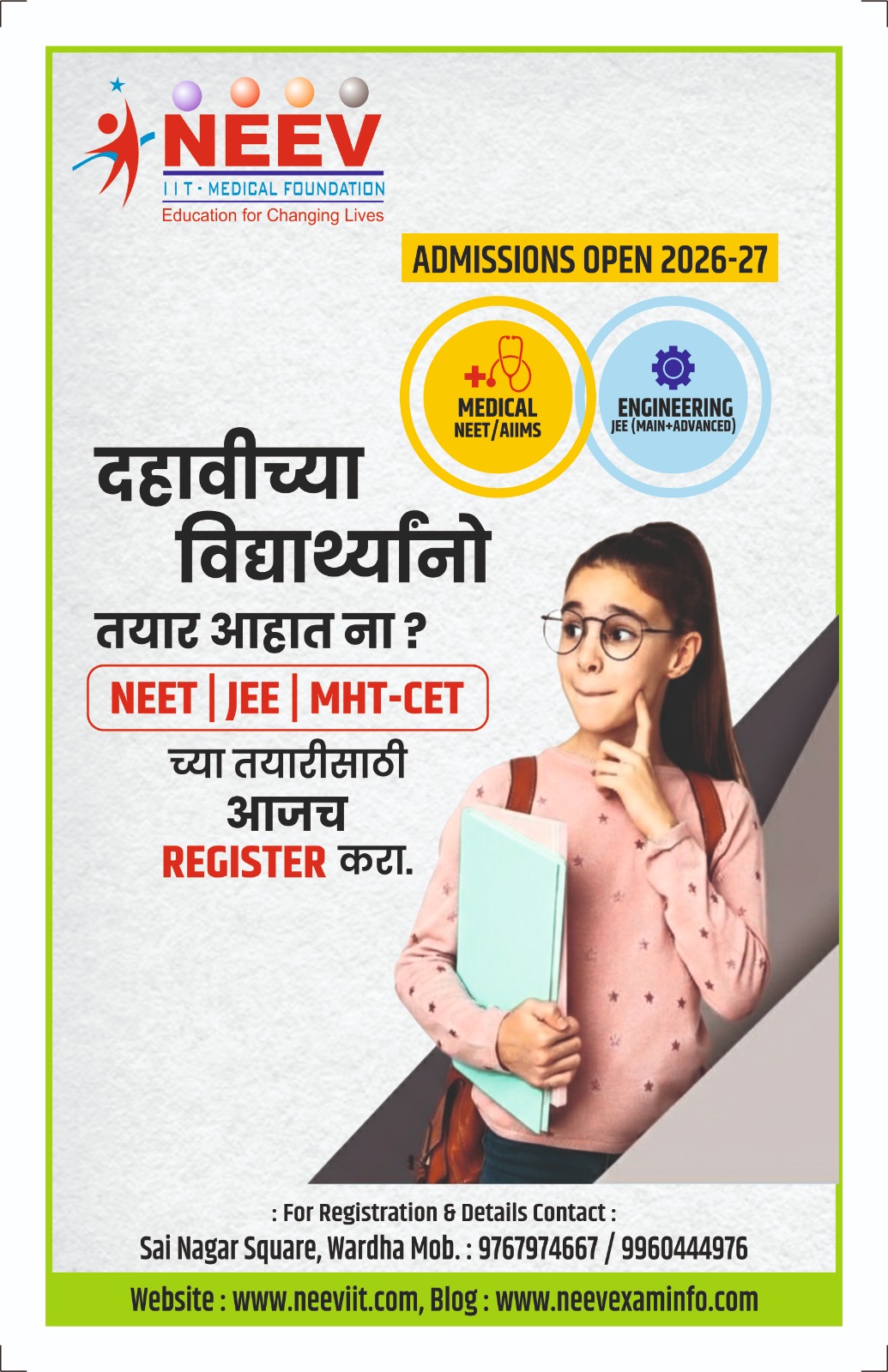
Ad,issions Open
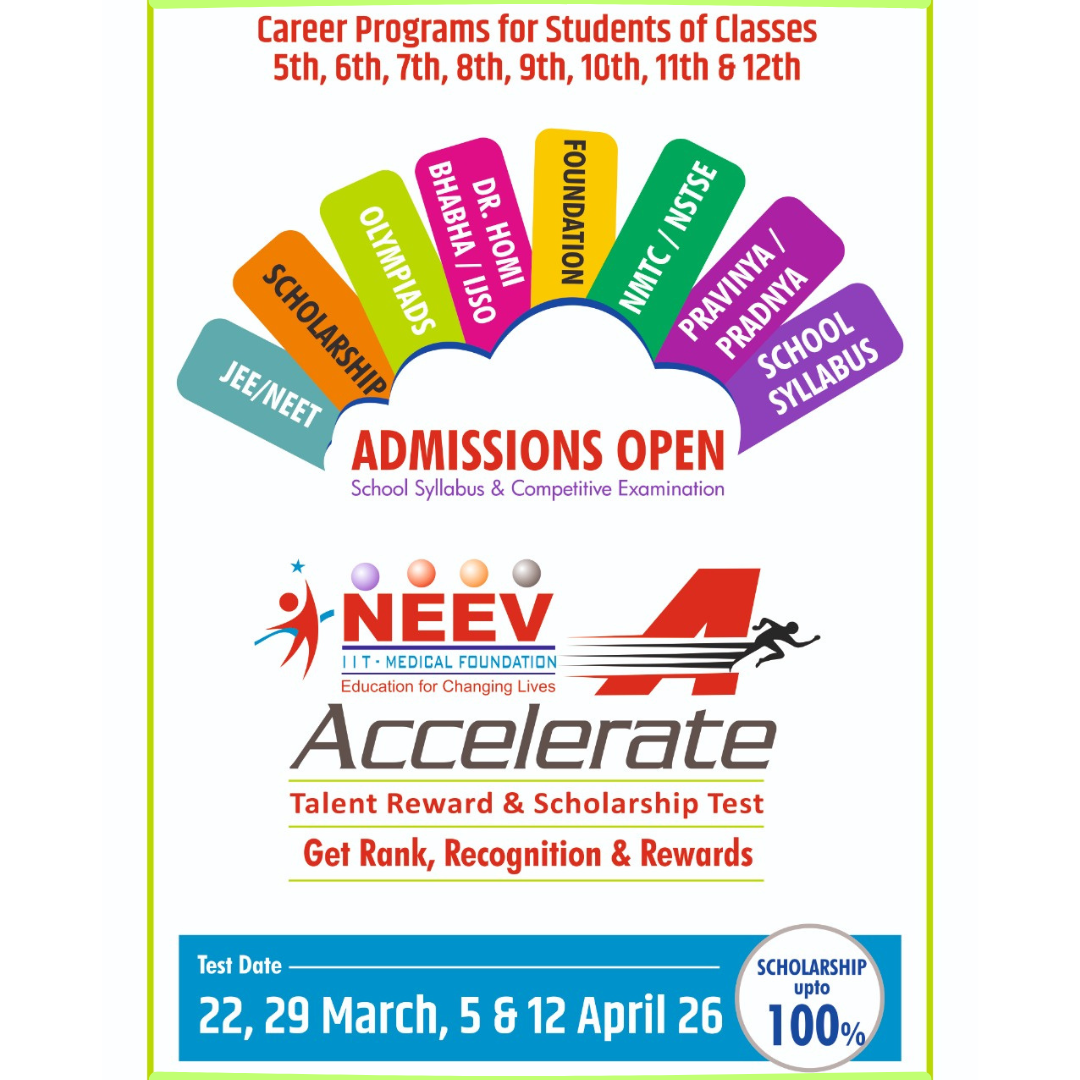
Neev Accelerate Talent Reward Exam 2026
Accellerate Talent Reward Exam’26


 Neev IIT Medical Foundation