What It Means, Its Pros & Cons, and How Students, Parents, and Coaching Must Respond
JEE Advanced has always evolved to stay ahead of rote learning and pattern-based preparation. Recent trends suggest that the examination is exploring adaptive-style assessment principles—not as an immediate implementation, but as a possible future direction.
⚠️ Important clarification upfront
JEE Advanced 2026 is NOT an adaptive test.
The 2026 examination will be conducted in the existing format.
However, the performance data and response patterns of the 2026 batch are expected to serve as a reference sample, based on which future examination strategies may be evaluated.
Understanding this distinction is essential for students and parents.
🔍 What Is Adaptive Testing?
Adaptive testing refers to an assessment philosophy where:
- The exam focuses on depth of understanding, not repetition
- Questions are layered from basic concepts to advanced applications
- Partial knowledge is exposed and penalised
- Accuracy, judgement, and composure matter as much as knowledge
⚠️ Clarification again
Adaptive testing here refers to exam design philosophy, not a computer-controlled question-by-question adaptive system like CAT.
🧪 Role of the JEE Advanced 2026 Batch (Sample / Reference Group)
Educational analysts believe that:
- The JEE Advanced 2026 batch will act as a reference or sample group
- Their performance data will help exam authorities study:
- How students respond to higher conceptual depth
- Accuracy vs attempt behaviour
- Time management and decision-making patterns
- Based on this statistical and behavioural analysis, authorities may:
- Decide whether adaptive elements should be introduced
- Determine the extent and manner of any future changes
In simple words:
2026 is a data-gathering and evaluation phase, not an implementation phase.
Any structural change, if approved, would be introduced only in later years, after careful analysis.
🔁 How This Differs from Conventional JEE Advanced
Conventional Approach
- More predictable structure
- Familiar question types
- Advantage to repeated practice
- Speed and volume of attempts mattered more
Direction Being Evaluated
- Reduced dependence on fixed patterns
- Greater emphasis on concept integration
- Accuracy over number of attempts
- Stronger testing of exam temperament
This shift aims to assess quality of thinking, not quantity of practice.
✅ Pros of an Adaptive-Style Approach (If Implemented in the Future)
1️⃣ Rewards True Conceptual Understanding
Students who understand concepts deeply benefit more than those relying on memorisation.
2️⃣ Reduces Guesswork and Luck
Multiple-correct and numerical-type questions discourage blind attempts.
3️⃣ Better Rank Differentiation
Adaptive-style assessment separates students more meaningfully, especially at the top.
4️⃣ Aligns with IIT Academic Demands
The focus moves closer to:
- Problem-solving
- Logical reasoning
- Handling unfamiliar situations
⚠️ Challenges and Concerns
1️⃣ Psychological Pressure
Unpredictability can increase anxiety if students are not mentally prepared.
2️⃣ Time and Risk Management
Students must decide not only how to solve, but whether to attempt.
3️⃣ Partial Preparation Gets Exposed
Surface-level learning becomes ineffective.
🎓 Role of Students
Students should:
- Build strong fundamentals
- Practise mixed-concept questions
- Learn intelligent question selection
- Develop calmness under uncertainty
In such exams:
Attempt quality matters more than attempt quantity.
👨👩👧 Role of Parents
Parents should:
- Understand that rank fluctuations are natural, especially during transition years
- Avoid judging ability based on a single test
- Focus on consistency, not instant results
- Provide emotional stability at home
A calm parent environment supports better exam performance.
🏫 Is This Making JEE Advanced More Coaching-Dependent?
No — if anything, it reduces coaching dependency.
- Pattern-based shortcuts lose effectiveness
- Conceptual clarity and independent thinking gain importance
- Expensive material alone offers no advantage
Good coaching helps guide thinking, but cannot replace understanding.
🌾 Impact on Rural and Resource-Limited Students
Potential Positives
- Reduced advantage of pattern-heavy coaching
- Greater importance of NCERT-based fundamentals
- Less reward for rote memorisation
Real Challenges
- Limited access to mentors and adaptive-style practice
- Digital and resource gaps
With proper guidance and access, adaptive assessment can be more inclusive, not less.
🧠 Final Perspective
To summarise clearly:
- JEE Advanced 2026 will NOT be adaptive
- The 2026 batch serves as a reference sample
- Any adaptive-style implementation, if approved, would be introduced only in future years
- The goal is to identify genuine conceptual thinkers, not pattern-trained candidates
Students, parents, and coaching institutes who understand this evolution early will be better prepared, not anxious. Know More 9960444976
🏫 Our Response at Neev IIT Foundation
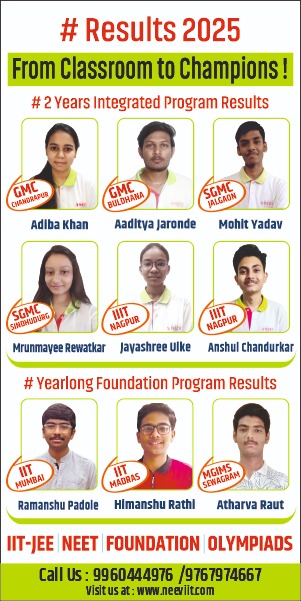
Understanding the evolving nature of JEE Advanced and the possible future move towards adaptive-style assessment, Neev IIT Foundation has proactively strengthened its academic ecosystem.
As part of this effort, several IITians and Medicos have been added to the Neev academic team, bringing with them:
- Deep conceptual teaching experience
- First-hand understanding of IIT and medical entrance expectations
- Strong focus on problem-solving, accuracy, and exam temperament
- Mentorship that goes beyond syllabus completion
Their role is not just to teach, but to train students to think, adapt, and stay composed—skills that are increasingly crucial in JEE Advanced.
Our objective is clear:
To prepare students not just for an exam pattern, but for any evolution the exam may undergo.
With strong fundamentals, guided mentorship, and emotional balance, students can face both present and future challenges of JEE Advanced with confidence.







 Neev IIT Medical Foundation
Discussion
No comments yet.